All Her Fault
I mentioned to my friend’s aunt that I’d been watching the limited series All Her Fault, all eight episodes of which are currently streaming on Peacock. (I’d read a bit about it, spoiler-free, on Pajiba, having initially visited the website in search of info about the cancellations of English Teacher and Poker Face.)
“Mostly it’s a depiction of the types of Husband from Hell,” I told my friend’s aunt. “You’ve got the husband who disappears during a crisis to pretend to poop for an hour while he plays Nintendo Switch in the bathroom. Conversely, you’ve got the type of husband who needs to be needed so badly, he will generate a crisis and then present himself as the solution—the fixer.”
I hesitated. I hadn’t watched the show in its entirety yet, I said, but I was pretty sure it was going to take “needing to be needed” all the way to its devastating logical conclusion. “It’s really a very nefarious quality,” I told her.
Well, I’ve seen the whole thing now. I can’t fully analyze All Her Fault without inadvertently synopsizing it, so I’ll stay tight-lipped. But I can say that it is about blame-shifting, finessing a savior narrative, and feeling a sense of entitlement to, or ownership of, others. (“I own you,” someone says when another character goes into financial debt. “I saved him; he’s mine,” another character insists.) There are also multiple “identified patients”: characters who are prevented from getting healthy because, if they ever achieved well-being, the prevailing hero/rescuer narrative would dissolve.
It’s really good. I loved it. It has the same appeal of Big Little Lies, which is to say, it handles incredibly painful subject matter in a very soapy way. It’s very clear-sighted in its aims.
Here are some other stray observations:
According to IMDb, the novel All Her Fault was originally set in the outskirts of Dublin. The television adaptation is set in Chicago and its suburb Wilmette, but principal filming was set in and around Melbourne, Australia. I have compared Melbourne to Chicago in the past, and I do think these cities are a lot alike! Their similarities do not translate onscreen. The houses look crazy. The trees look crazy. The sunlight looks crazy. Add an establishing shot of Dakota Fanning in front of the Bean, and you will feel like you are going nuts. If characters are gaslighting other characters, the show itself is gaslighting anyone who’s ever visited either Chicago or Melbourne.
In keeping with the above observation: The accents in the show are diabolical. One major character, hailing from Chicago’s South Side, has a mother who sounds like she is from Georgia and a father who might be from New York City, Maine, Massachusetts, and/or Delaware. I realize we aren’t all born sounding like Dennis Farina, and I accept that regional U.S. accents are flattening and fading in general, but Dakota Fanning’s husband and Michael Peña’s police-detective partner both had me on the ropes wheezing. Chicago is such a specific city to choose, and it’s a great setting for suburban noir. Why not just set the show in Melbourne instead? Why not be like “here are some Americans who live and work in Melbourne”?
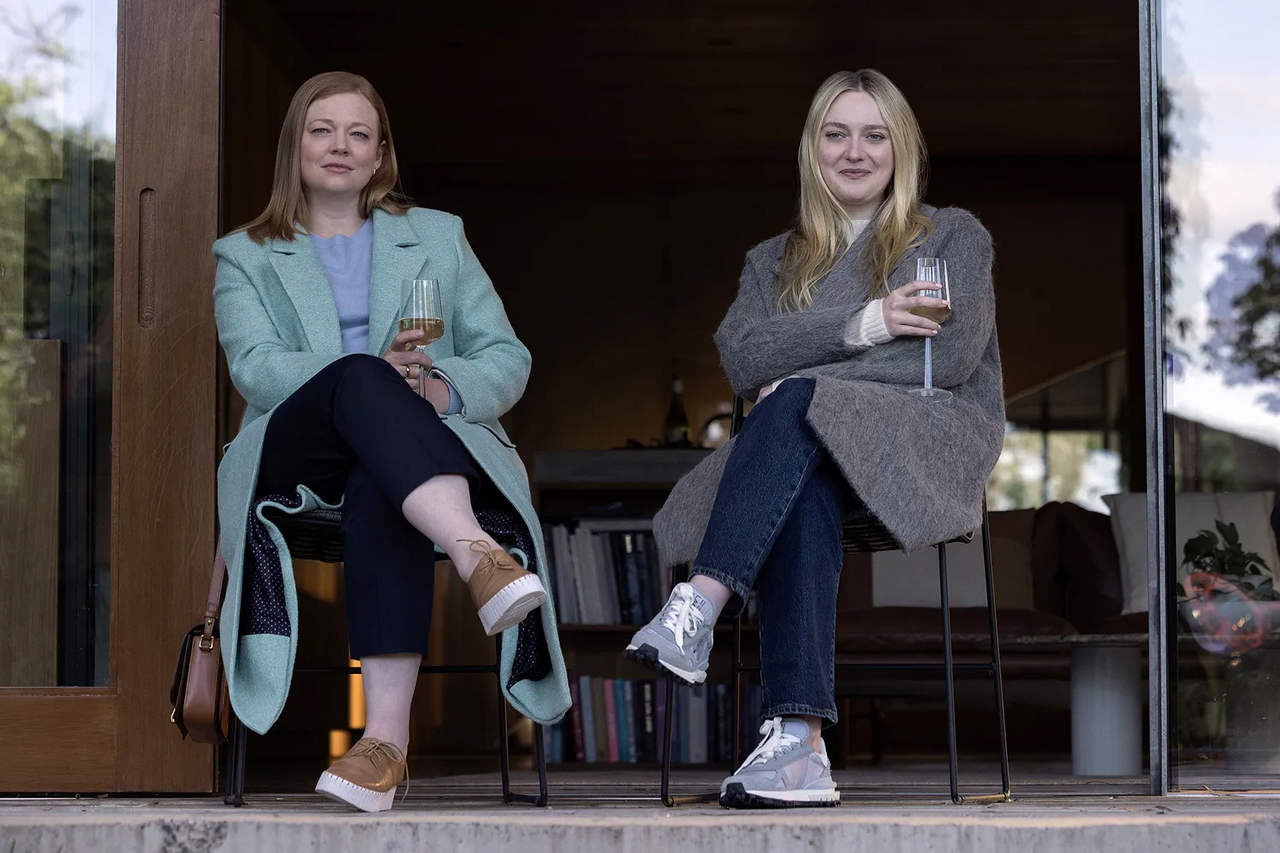
That said, Sarah Snook and Daniel Monks sound fucking amazing. Snook has an ultra naturalistic delivery, so she appends “yeah?” and “hey?” to the ends of her sentences, in a plausibly neutral North American accent, and it sounds fine when she does it. I wasn’t sure about Monks until he said “gull-friend,” which is a very tricky word. Anyway, he is a revelation. I don’t know if you’ve ever witnessed wheelchair acting before, but he steers around a scene with conviction and sass. (There’s a subplot about internalized ableism—which is rapidly un-internalized and recognized as the weaponized projection it is—so it matters that the actor twerpily free-wheels around in his motorized chair, utterly liberated.)
Accent work is really not that important, unless you set something in the Midwest, and then I demand pinpoint accuracy. Maybe if you cut every instance of the word “been” from the script.
I feel for Jake Lacy!!!! Here is a perfectly angel-faced theater kid who at one point wore braces and a retainer—like, he just looks like a nice teen boy to me—and he’s been so thoroughly typecast, every time he turns up onscreen in anything you’re like “ah, here comes a shitbag.”
It is well established that Michael Peña’s police detective solves everything like he’s in a point-and-click adventure game; I was dyinggg. At one point he was using his near-supernatural powers of perception and insight to narrow down which business to visit, and I thought to myself, “That’s definitely how you solve a mystery in a novel!” It’s exactly how I try to solve mysteries, and it does not work in real life. It’s very fun to watch, but I kept putting my face in my hands to cry-laugh.
How significant is my face-blindness? I used to think Michael Peña and Mark Ruffalo were the same person.
The series closes itself out with a tidy speech from Abby Elliott’s character about our human tendency to assign external blame in the ongoing effort to distract ourselves from our own internal pain. It’s a little annoying that this speech comes from one of the few characters who blames herself for everything, but I guess I don’t know who else would say it.
It is well worth watching All Her Fault, especially if you enjoy feeling feelings but only if they’re ensconced in a safe cocoon of trash first. It’s like sneaking medication to a pet in a Pill Pocket.