expansion/contraction

Gardens by the Bay by Kirill Petropavlov for Unsplash
I’d been tidying the countertop when I happened to notice a forgotten mug of coffee.
“Is this your mom’s?” I asked one of the teenagers.
“I think so,” he said. “Is it fresh?”
I felt the mug with my fingertips. “Yes,” I said. I hesitated. “Why don’t you add some half-and-half and take it in to your mom,” I suggested. “You’ll make her day. She’ll be so proud. She’ll think, ahhh, that’s my son.”
The teenager got to his feet and walked over to the abandoned cup of coffee. I stood back by the sink, watching. “Also,” I said, in a much lower voice, “thank you. I took your mom’s coffee in to her once, and it was a little weird. It’ll be less weird coming from you.” Perhaps I didn’t know her well enough to cream up her coffee and take it in to her. It hadn’t been awkward until I’d appeared and handed it to her, and then it was really awkward. I hadn’t intended to be some sort of coffee interloper.
He’d added half-and-half. “Do I add creamer too?” he asked me. “Is there a separate…?”
I resisted the instinct to smile. “Uh,” I said. “There are many types of creamer. Half-and-half is considered one possible type of creamer, maybe even the preferred type.”
Now he had a bottle of whipped cream in his hands. “I did this for her once before,” he told me, as if to preemptively reassure me that nothing had gone amiss yet. “She liked it.” He was beaming. I nodded impassively. He proceeded to bedeck her mug of drip coffee as if it were a Frappuccino.
“Very good,” I said with a straight face, refusing to allow myself to have a single thought or opinion about the young teen’s creative process. He left the room. He returned, jubilant.
“Thank you,” I said. “You have made my day.”
“I was thinking last night,” my best friend told me a couple weeks ago, “that you writing again is really miraculous.”
Ah yes, the ol’ Writers’ Block, my nervous system’s total paralysis. I was pacing around the room while on the phone with her.
“Uh, well,” I said. “Okay. After GamerGate, every time I’d sit down at a blank screen, I’d start trembling.” Full-body-wracking panic. I was terrified, too terrified to get a word down: Is someone going to get angry. Will I be found. Will I die.
“This,” I continued, “is what every writer constantly experiences, it’s just that what I was experiencing was a more dramatic version by an order of magnitude.” It had become a life-or-death question for me, but the starting point is the same for everyone: left alone facing all the ways this self-indulgent exercise could go sideways.
“Really?” my best friend asked, sounding genuinely aghast.

by Kelly Sikkema for Unsplash
“Oh, sure,” I said, “this feeling of being under threat, being imperiled. Every time anyone sits down to write, everything will be swimming along okay until they start imagining who else might read it. Today might be the day a writer loses someone over one misunderstanding, one mistake. Will they hate me, will I die. And I mean, probably you won’t die. But there’s always one lunatic.” There’s always a nonzero possibility. You just hope someone doesn’t have the time for you, and you do what you can.
A few days later I’d phone my best friend to tell her I’d signed up for yet another overpriced identity-hiding service, letting two different services overlap in coverage for a while.
“That’s a good idea,” she said.
“Yeah,” I said. “I’m sorry, I just didn’t expect to feel this overexposed so quickly.” I’d meant to sign up for it on another day, further into the future, perhaps. This day had arrived sooner than I’d expected, I explained to her.
Later that day I hadn’t pushed my A.V. Club article as hard on social media as I previously would’ve, with anywhere near the same hustle (“ICYMI”). People had heard well enough from me lately; I don’t want to Anne Hathaway myself. This is what I mean by contraction. I am learning to contract.
A fact that I struggle with is, when pressed, I lock down and shut up, or even ‘ghost’. I have lovingly blocked people I care about by hand (also, the Vice President? It’s weird). However, when I am feeling even only vaguely threatened, I start overexplaining, opening up and talking a mile a minute, increasingly frantic. This instinct to ‘open up’ at the least appropriate time is a fawn response and, because my nervous system was cultivated in highly authoritarian settings and still has not unlearned this, I routinely fuck this up. Meanwhile, I self-protectively ‘contract’—I do not fawn—when it is a person I know and trust.
To my mind, this makes perfect sense: if there is a behavior that I find corrosive to a relationship I do value, I pull the emergency brake without thinking. (I’m trying to knock this off.) As for the fawning, I’m beginning to realize that there is no amount of ‘work’ or ‘ego death’ I can do that will stop my nervous system from frying and blowing out when every alarm bell is firing in my body. When will I understand that this isn’t a moral or demyelinated failing on my part—a failure of patience, of grace, of endurance—and that being on the precipice of crying, screaming, throwing up, is my body working exactly as intended?
I think the worst part of all, though, is how other people seem to intuit I’m the ‘weak link’. When I’m standing in a long line that snakes around and blocks a walkway and someone needs to cross, they choose ‘in front of me’ for where to ‘break’ the line and pass through. When an animal wants a snack, the animal starts with me, the easiest target, while giving me the big wet round eyes. I hate this. I hate being the path of least resistance. (“So,” my friend Scott recently realized out loud on the phone, “you’ve been held up at gunpoint twice?” It was true, and I laughed. But isn’t the husky holding me up at very gentle gunpoint all the time?)
I heard recently that “always seeing the good in others” “is not kindness.” Rather, it is an early childhood survival mechanism: if you’d perceived your caregivers fully as they were, you would’ve spent all your time fucking terrified. That’s the first hostage situation.
My best friend and I had been discussing Star Wars and certain casting decisions, and others’ opinions of those decisions.
“People who like Star Wars,” my best friend began. She shook her head, too exhausted to continue her thought, perhaps.
“They feel ownership over it,” I said.
“Yes! It’s like they—well, it’s what you were talking about.”
I looked at her blankly. “Oh,” I said. “Oh, yeah, I did just write about this. To love something, to declare war on it.” I nodded. “I just can’t with fandoms,” I continued. “I’ve never been able to make myself be a part of one.” They drive me off. “Doctor Who,” I suggested now, gesturing toward her. I’d regrettably gotten her into the TV show a couple years before it’d amassed a much wider audience.
Her face turned a new color. “Oh, okay,” she said. “I was in this Facebook group. This woman corrected me. I’d typed ‘Dr’ and she told me it had to be spelled out each time. ‘Doctor’.” She rolled her eyes. “Well, I did it again, and she replied again. ‘I thought I already told you—’ Well, once you tell me something like that, I’m like a tick on a dog.” She made claw fingers and pantomimed pouncing.
“Right,” I said gleefully, “thanks for letting me know this thing bothers you so much.” We snickered. “Well it’s a type of prescriptivism,” I said now, sighing. “Language is mutable. The point is presumably to communicate clearly, to be understood. But if you’re already communicating clearly, then it’s their commitment to misunderstanding you now. Their commitment is only to being right.” I nodded. “And sure, using language as a signifier, showing they’re a member of an in-group.”
“Yes!” my best friend exclaimed, clarifying what type of Facebook group this had been, the kinds of interpersonal dynamics involved. “So when she said ‘I already told you’…”
“Right. Here’s how to be identified as ‘in,’ a true fan.” Why won’t you care about this? Why won’t you let me be your Cher Horowitz? I groaned. “It’s like, are you grading me?”
One of the caregivers has been let go. I was not part of that decision-making process. Something I did firmly suggest at one point, though, was “If the only reason she’s still here is, you’re scared of what she’d do if you ever let her go, that’s a hostage situation.”
That was pretty good advice! I should learn to take it. My childhood friend and I have had difficulty coming to terms with the entire concept of protectively ‘closing ranks’, because we ourselves were both treated as outsiders in our insular, isolationist hometown. Only in a more nurturing, open environment had my best childhood friend begun to thrive scholastically and perhaps also interpersonally.

by David Clode for Unsplash
There’s a friendly acquaintance, a distant colleague, who was moved by my blog ruminating on hypercompetitive family systems. (The family I’d observed in a sit-down franchise restaurant was “playing a zero-sum game,” he warned on social media, “and I know where that leads.”) Apart from me, he had separately been ruminating on ‘in-groups’ and ‘out-groups’, worrying that his own skillset had atrophied, that his status as a valuable team member might be in question, that his safety is in check. Meanwhile, the industry—many industries—is rapidly sinking, and his pro-social impulse is to pull as many warm bodies onto the life rafts as possible, to link arms.
I tried to not be totally obnoxious, but I’d been a real reply-guy lately, an absolute bee in his bonnet. Yes, yes, I know, I know.
Finally I showed my full hand to him: I have always tried to pull people into my life boat. The impulse is one of generosity, an awareness of how it feels to be left behind. Positive, even miraculous things had occurred as a result of this instinct. But I have also imperiled others by refusing to close ranks when it would’ve absolutely been appropriate to do so. I have also put myself into potentially dangerous situations, which invariably leaves others with the burden of ‘looking like the bad guy’ by doing what I apparently will not, whether for my own sake or for the collective’s. (I wrote it all out in a series of long threads, offering specific examples, which I’m too tired to reproduce here.)
I was reluctant to frame any of this in us-versus-them terms, since people under duress can behave desperately or turn on a dime, surprising you, but there is something to be said for closing ranks, “putting up a mean sign on the clubhouse door” if only temporarily, not even as a punitive act but, rather, “quarantining a member” “to prevent further dismemberment of the body corporate. Is any of this making sense at all?”
My small group of friends does not mean-girl anybody per se, but when one of us is under some sort of direct threat we sort of collapse inward, briefly ensconcing that individual. “Really, I imagine a sea creature,” I told another friend recently, “the way it contracts.”
“A sea anemone,” she suggested.
I wasn’t sure. “Are they grouped in colonies?” I wondered. Neither of us was sure, but she thought maybe yes.
I have to take time to reset after any social excursion or outing, big or small. I have to contract. This looks like naps, dim lighting, lots of water, maybe food that is a little lusher and greener than might be my norm.
“I learned it in L.A.,” I explained recently. My friends had tenderly teased me about my monastic apartment, but I’d been relying on that space after every excursion, every exposure: “a return to the womb,” I suggested now. (“This sounds like a kiva,” my friend volunteered.) In particular, I have to sit and process—digest and metabolize—the accretion of interactions. Part of it is determining which feelings actually belonged to me and which did not. I have to consciously sort through what is actually mine to carry.
Last week I was scrolling through social media, and I paused to watch someone’s video of the ride Peter Pan’s Flight, perhaps the Disneyland version. Everyone agreed they were glad it had barely been updated. Someone posted a comment about being five years old and “thinking I was really flying over London,” she wrote, which was followed by a bunch of comments of assent (“same but I was 9”).
I raised my eyebrows. I was six or seven and I thought we should be higher up than we were, or that the angles could’ve been more clever, because it really looked to me like the dirty floor of a warehouse with Big Ben poking up out of it like papercraft.

That iconic moment when your little flying ship finally breaks free of London, entering an expansive space. The city recedes into what amounts to some painted spots on the floor—an illusion that requires very low lighting, and which had failed to fill me with any wonderment or overwhelm as a kid. “This is just a large, empty room,” I thought to myself all surly. It looked like a liminal space, a transition between other, more important scenes, unfilled filler just to manage and pace the flying boats, to keep them from bumping into one another: a truly thankless workhorse of a room. I love this ride, by the way, but not like I love Mr. Toad’s Wild Ride.
I’ve always been impressed by very, very good illusions but annoyed by average ones—sometimes, outright scared of them, like “why am I expected to pretend I believe this transparent fabrication”—and it’s unnerving how many people will come to you wanting to hear a strange bedtime story about themselves.
I’ve been thinking a lot lately about parallels, the structural similarities, between my hometown, my one office job, dysfunctional families, my own internal family system, and a cult. I think if there is a single scapegoat—that is, a house of cards’ load-bearing pillar, any one person whose silence and labor and complicity are required to keep the whole thing from collapse—you should probably just walk, letting it fold.
Four or five years ago I’d asked David Gottwald to give me a crash course in theme park design. He’d started by recommending books to me about Disney “imagineering,” coming up with a list off the top of his head.
Then he asked me what I knew about Japanese garden design.
“Uhhh,” I said.
“Expansion and contraction,” he told me.
He explained: you, the journeyer, are forced down a bottleneck, across a small bridge or through an arch. This is contraction. Then the clearing opens wide in front of you, your vision becoming unrestricted. You, the visitor, should experience an awe or wonderment. This is expansion. You, the visitor, might wander, choosing the next path; in a well-designed space, your journey will be a constant tension between these two experiences of expansion and contraction.

photo by Junho Kwon for Unsplash
I was recently recounting Dave’s lesson to a friend of mine. The social media algorithm had started serving me slideshows about the ‘garden of your mind’. Philosophers believed this ‘garden’ could be either cultivated or else overgrown—wild and feral.
It’s funny, but when I’d seen The Secret Garden in a movie theater in 1993 (and only then), I’d gasped at the first sight of an overgrown wonderland. As is promised by the book’s plot, the garden’s glory is inevitably trimmed back into a “proper English garden,” I said to my friend, “and then I was like, ‘Oh. Y’all did way too much.’”
“Culling. Too much control,” my friend suggested, “too much order.” Ah, yes, it had been the chaos of an ungovernable wilderness—the possibilities!—that had taken my breath away, until an almost totalitarian control had starved the garden into just a glorified lawn.
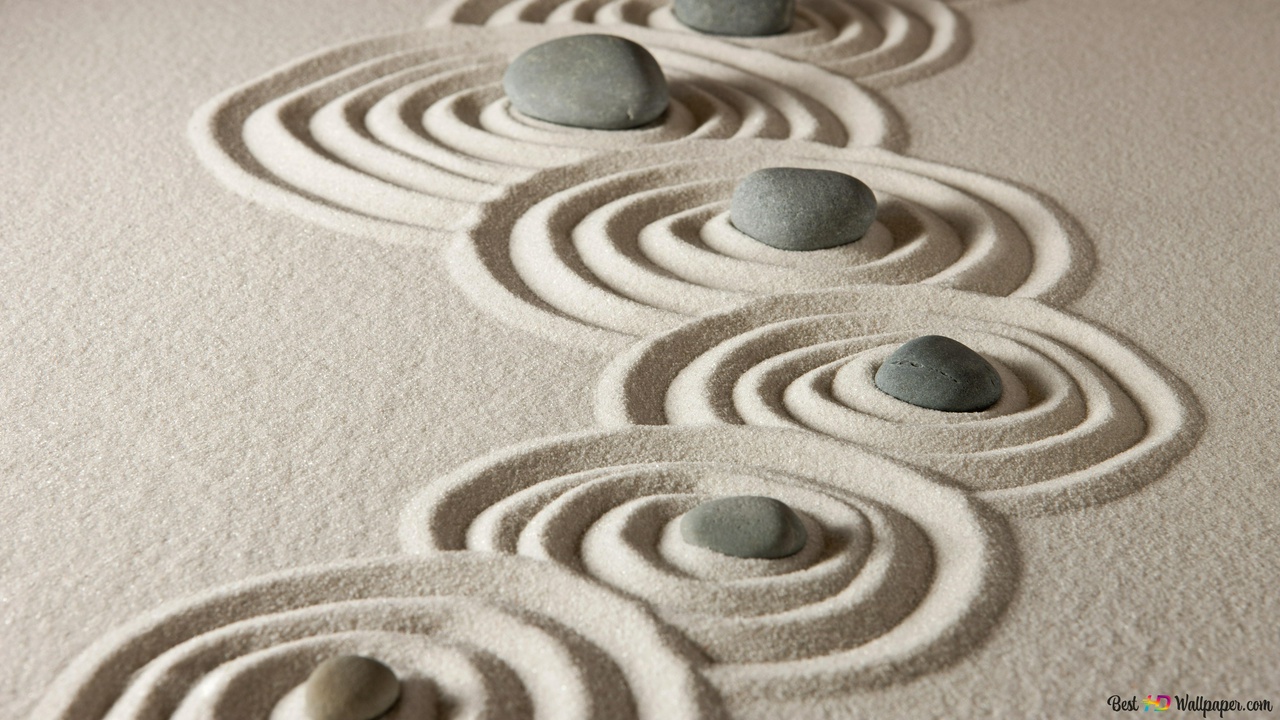
“I think about this constant expansion and contraction in terms of quantum mechanics,” I continued. “You know probability clouds? It’s like this zen garden. They get forced through a bottleneck, a sort of gate—”
“Collapsing wave function,” my friend said in recognition. Yes! Observation, measurement, decision-making, is how we ultimately materialize in the ‘correct’ reality. I don’t know what I actually believe about this for sure, except that, in practice, it’s surely like walking through a Japanese garden.
My friend asked me if I’d seen Dan Cook’s (Spry Fox) blog post about the creative design process—and, more specifically, Dan’s diagram, which illustrates that process. “It looks like a snake that has swallowed some apples,” she advised me, so that I’d be able to pick out the diagram from an Image Search.
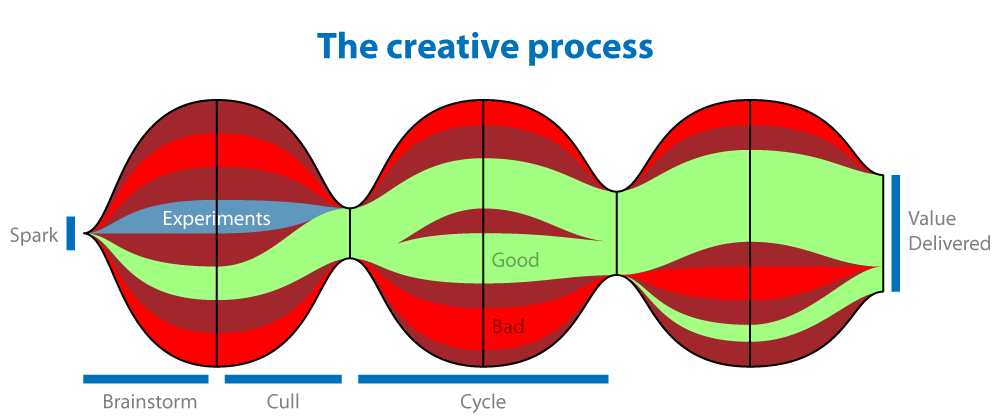
Dan Cook 2010
She recommended that I also read the blog. I’m finally looking it over, and it really is the practical application of a quantum idea, and maybe a simpler way of understanding parallel thinking, too. Unfortunately I hate decision-making; I hate ‘locking in’ and have since I was a kid. Why not wait for doors to slam themselves shut? It’s a brutal way to live.
That night I had lots of dreams I don’t remember, but they’d culminated in the sight of two coins of equal size being slid together, so that their edges were just touching, and then I realized there was something like a flicker gilding their perimeters, repeating a figure-8 shape.
The sight had caused me to wake up. I opened my eyes and contemplated this. I thought about the cosmic planets aligning like chakras, the long squiggle tracing around the planetary bodies like SkiFree slalom.
Oh, sure, I realized, scoffing, everyone already knows that! The caduceus, the double helix, etc. Zzz. Whatever. I went back to sleep.