it’s what’s inside
This post was originally supposed to be an adjunct to Matt Cardin’s “Don’t Deny Your Daemon,” about Mary Shelley’s Frankenstein and how psychological repression has led us to this fraught contemporary moment.
Unfortunately, I continued to find other odds and ends in my notes app, so this is now an incoherent mishmash of ideas.
draft from November 2025
Something I think about a lot is how demons didn’t exist in Japanese culture at all (*feel free to check me on this) until the rise and spread of Christianity, at which point a lot of benign animistic spirits were ‘demonized’. Because of Greco-Roman influences on the Bible’s language, a lot of its verbiage is geared toward ideas about the justice system, legality, war, and rules of engagement. Well, demonizing something is the first step to declaring war on it. (And, equally, using ‘war’ language about a neutral topic is what demonizes it. War, what is it good for?)
Similarly, I find myself contemplating superstitions about flies. In the Bible a lot of dramatic infernal meanings are assigned to these little disease-carrying house-pests but, in almost every other ancient culture around the world, flies are messengers asking a person to take notice and consider what is bothering them internally. They are a divine suggestion to deal with your shit.
The version of Christianity I grew up with encouraged going to active war with one’s own subconscious, battling one’s own psyche. This isn’t to say that everyone does not have personal demons clamoring to be witnessed and addressed. But contemporary understandings of Protestant Christianity tend to call for their utter rejection and expulsion, rather than negotiation and peace treaties.
Recently, TikTok video creator T Avery Norkey staged and streamed an elaborate live LEGO version of Andrew Lloyd Webber’s Phantom of the Opera, in “toy theater” fashion, using the audio of the filmed 2011 Royal Albert production. I really do not love that particular audio, but it’s the only complete filmed stage version anyone can get ahold of. Obviously no one can do it like Michael Crawford, whose “iron fist in a velvet glove” tenor is unmatched in its menace. Also, in its self-pity. Crawford’s tortured vulnerability elicits a real “I can fix him” feeling. The 2011 Phantom, conversely, is a little yelly. I guess that guy is most fans’ favorite, though.
Anyway, in the words of LEGO Phantom of the Opera (in a Batman cape), “Look at your face in the mirror! I am there inside!”
Then the full-length mirror slides open and the Phantom, who is not a metaphor, kidnaps Christine through it. Who is the Phantom to Christine? Why is she into him? He’s pretty explicit about demanding she cede her bodily autonomy to him, in exchange for, what, some singing lessons; he is not a man of subtext. Like, all his lyrics rhyme.
But throughout her kidnapping Christine still seems convinced she is having some sort of supernatural experience. You see, her dad is dead, and before he died he said something weird about eventually sending an “angel of music” to her, and maybe the Opera Ghost is somehow an incarnation of her dead dad?? Girl, no. He’s just a dude living in the sewer.
The Broadway musical makes apparent—as does the original Gaston Leroux novel—that the Phantom is also a terrorist, bombing the Paris Opera House and strangling victims unless they agree to put on his baffling and grotesque musical compositions. He isn’t an artist; he’s just a regular grandiose lunatic. Hey Christine, what about your childhood crush, the one who keeps signing up for your Patreon? He seems nice. No?
Yep, Christine has a ‘broken picker’, a Wile E. Coyote cutout in her heart in the shape of her missing dad. This is probably the reason to look your grief in the eye and kiss your shadows right on their ouchies: you’ll be a sitting duck for every guy in a half-mask until you do. (I’m not enough of a Twilight scholar to speak critically about it, but there’s a lot here about emotional and religious repression and the Mormon romantasy coercive-control fetishization danger zone. “I could date a vampire! I’d give them just the exact correct non-lethal-to-me sip of blood each time!”)
The Phantom is, of course, yet another Bluebeard in disguise: an obsessive artist. One of the few lyrics left intact from the 1986 pre-musical Phantom single starring the late rocker Steve Harley—from back when the rock opera was more obviously based on the movie Phantom of the Paradise—is (Brightman) “I am the mask you wear”; (Harley) “it’s me they hear.”
That is to say, in the thrall of her own ambitions, Christine is volunteering to function as the Phantom’s emissary in the world—a representative, a messenger, the “face of the operation”—for a man who eschews being seen clearly in the light of day. This is framed as romantic, presumably because pop-opera star Sarah Brightman, the original Christine, was married at the time to Sir Webber, the composer, in a little bit of hair-curling parallelism.
There’s something to be said here about Christine’s inability to fully own her ambitions. It’s easier to be perceived as a naive ingenue, rather than anything as monstrous as the Opera’s resident diva Carlotta: hungry, driven, confident. (The movie Showgirls almost functions as a narrative corrective here: Nomi Malone comes closer to becoming a fully integrated human than Christine Daae ever does, because she pushes Gina Gershon down a flight of stairs. I’ll leave you to grapple with these implications.)
In the afore-linked music video for the 1986 Phantom single, the Phantom spies Christine’s date Raoul in the audience, so he jealously drops a chandelier on him.
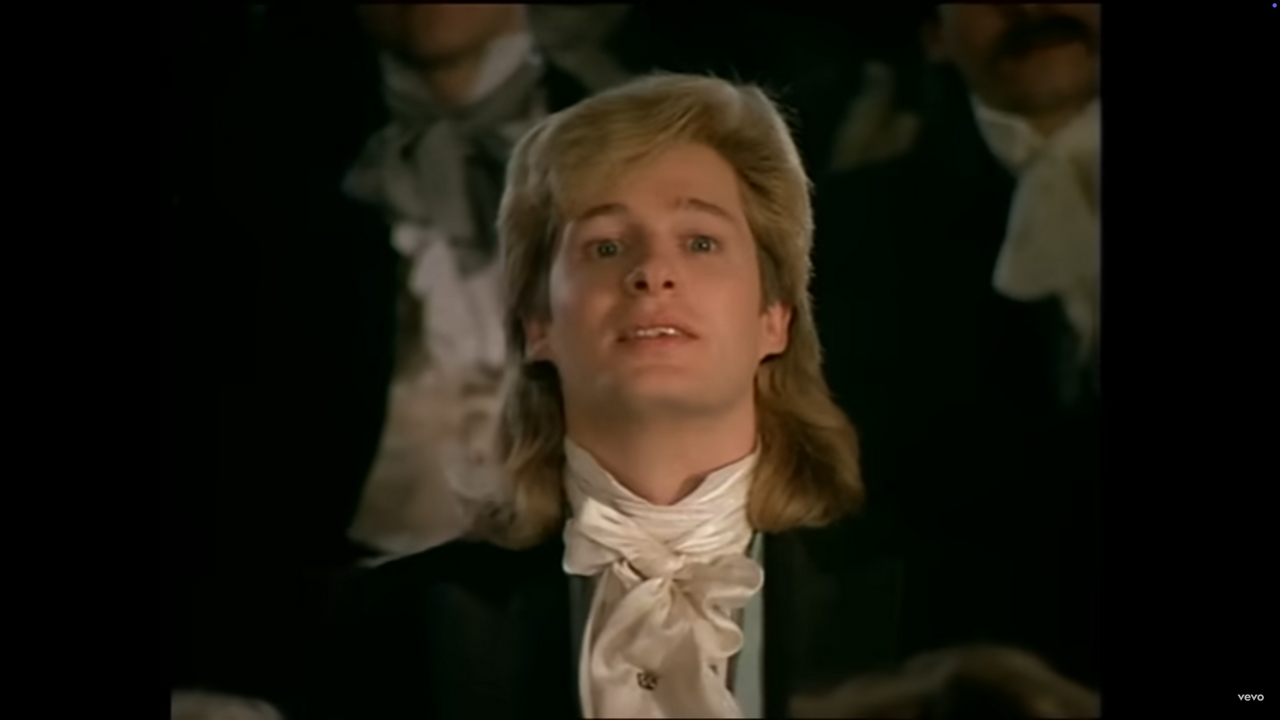
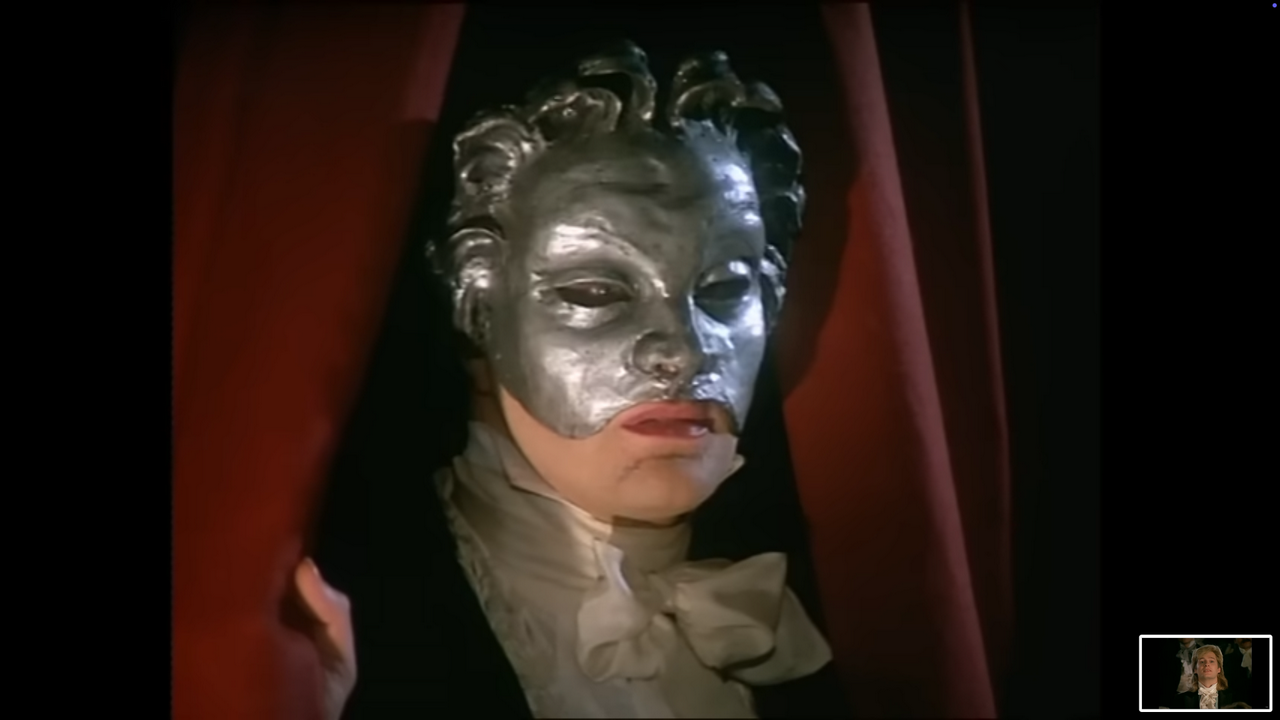
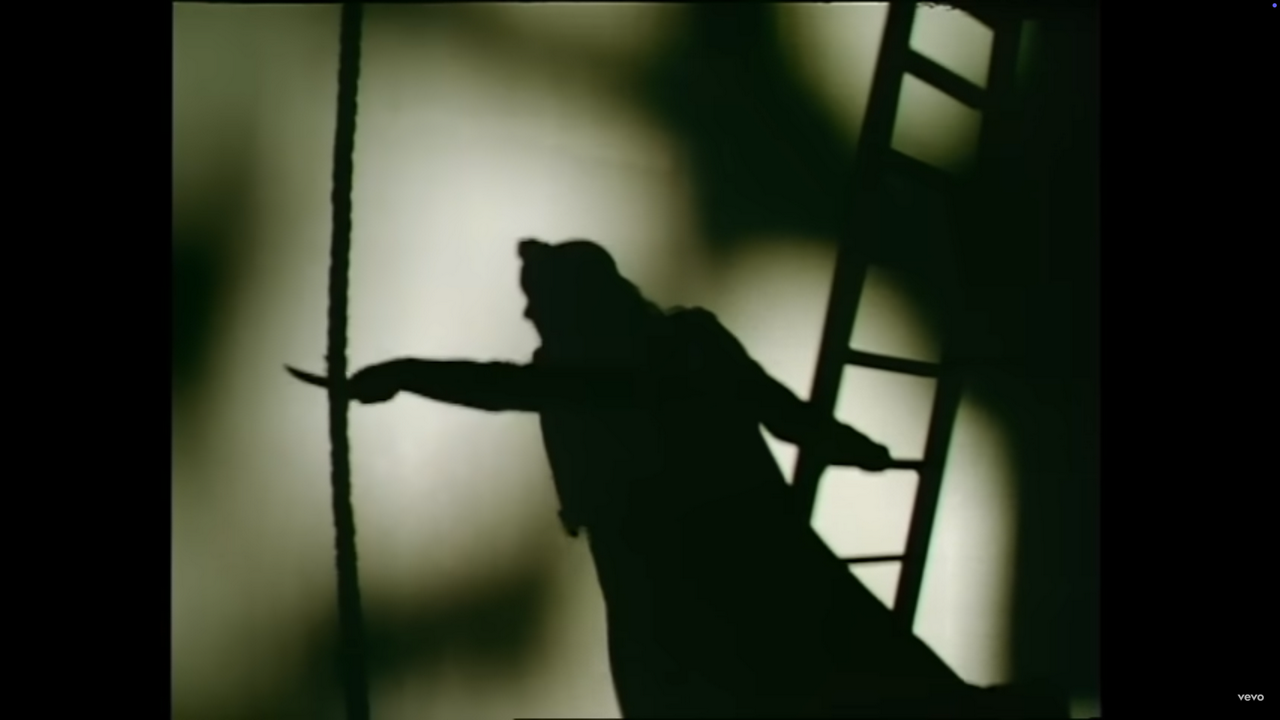
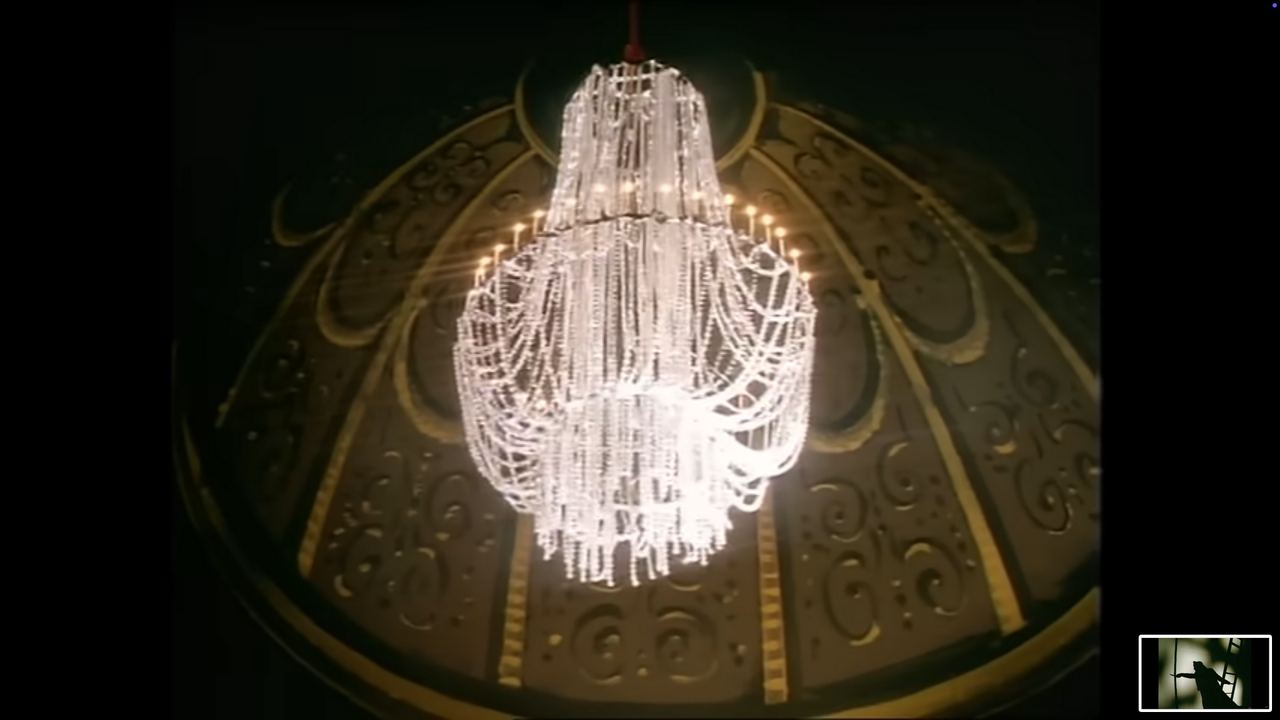

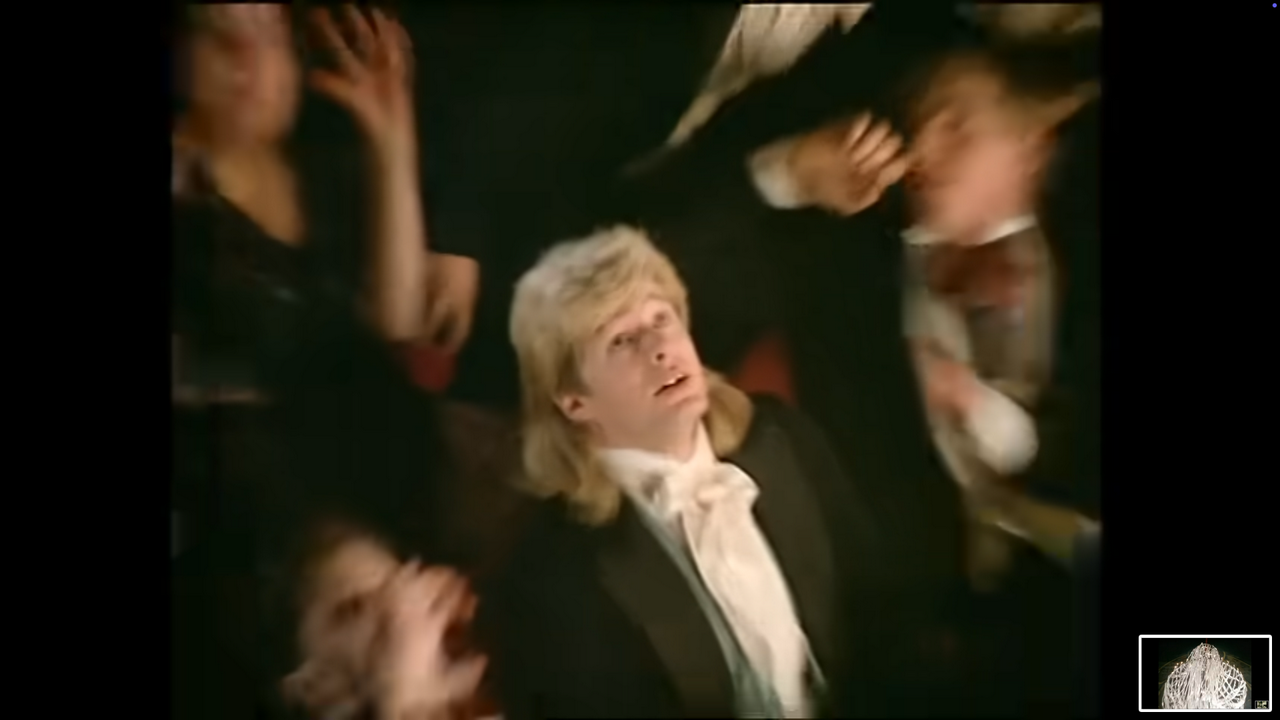
The most interesting thing about all this is the way Raoul is also played by Steve Harley (or perhaps a lookalike? I apologize, all lantern-jawed blond men look the same to me). Explicitly dropping a chandelier on yourself gives the music video a Jungian frisson: Raoul’s shadow has finally won.
“Don’t ignore your Daemon; it’ll kill you when you aren’t looking” is pretty sound life advice.
Raoul, it should be noted, is not an artist himself; he’s an opera-goer whose high-minded patronage single-walletly keeps the Paris Opera House running. Christine, a wannabe-singer, is in constant internal debate over which of these men she should sell out to. The real tragedy is that Christine is involved at all; the Phantom/Raoul is fully capable of having this internal battle all by himself. (February update: I recently encountered a trove of TikTok comments making this exact case. “Now kiss.” I fully agree.)
Really, Christine is just the externalized ‘turf’ in one man’s internal spiritual battle. They could just keep fighting over who gets the box seating, but no. The Phantom wants love! Maybe Raoul wishes he were a composer! And now it's everyone's problem. Men will literally set explosives in the opera house instead of going to therapy.
February update: ‘Us’ spoilers
I am realizing that I should really rewatch Jordan Peele’s Us (2019). Unfortunately, the meaning of the movie is entirely contained in its ‘twist’, so heavy-duty spoilers follow:
The main character and her family have been terrorized by their doppelgaengers. During a final villain speech, the primary antagonist, “Red,” describes the horror of being “tethered” to the main character, Adelaide. Their fates entangled and mirrored, Red has fought for agency, has organized a whole doppelgaenger uprising against the ‘prime’ characters. In the final moments of the movie, the audience learns that, when the main characters were both children in 1986, the ‘shadow version’ of Adelaide successfully swapped places with the original Adelaide (through, what else, a funhouse mirror-maze mirror), leaving the ‘real’ child in a temporal underworld. Ever since, the shadow self has worn a ‘mask’ of basic normality and fitting-in-ness.
So what has been terrorizing the ‘top-world’ main character—tugging on the tether between them, trying to recover autonomy or driver-seat privileges—is, not a shadow or a demon or a djinn, but in fact her own ‘real’ authentic self. This is incredibly crucial: what has been mistaken for a Jungian shadow is in fact the original inner child—who is now damaged and angry due to a destiny-swap and a life of high-masking lies.
I recently had/still have the flu and, during a number of fever dreams, I did at one point land on the completely obvious realization that there is a ‘collective shadow’ and, by reclaiming and reparenting my own shadow, I might diminish the collective shadow by one, my own. Again, very obvious stuff.
This has subsequently been complicated by the question of “which one is the real me?” The question is itself a false binary, but it gives my ‘shadow’ a lot of righteous justification for fucking with me, per the logic of Us.
notes: Reading Ghost World (2001) as a Jungian text about projection and transference
The villains in Enid Coleslaw’s life deserve examination. First there is “Melorra,” a theater student who reeks of desperation. She constantly beelines into Enid and Rebecca’s personal space, irritating them with her refrain about “getting together” over the summer. I think in my 20s I, like the protagonists, interpreted this corollary character as being fake—what does she want from them?—but as an adult I can see that the character is painfully alone, locked inside of her own self, a ‘theater kid’ only because she’s made an art out of trying to pass as a regular, neurotypical human. To the outside observer, Melorra is ‘cringe’ simply because she has never learned how to ‘match energy,’ so her repeated bids for connection go unanswered. Instead, Enid and Rebecca go flat in her presence; rather than mirroring their apathy, Melorra nobly doubles-down on her manic energy. In other words, Enid hates Melorra because she won’t mirror her.
The entire movie is about mirroring—and about what happens when we don’t like our own reflection. The town’s film and pop culture nerd, for example, is a raging antisemite, who constantly projects a gross narrative about a preoccupation with money onto Enid, a teenager, who is the target of his edgelord ‘jokes’. Later, when Enid walks into the comic book shop wearing a leather jacket and dyed green hair, he tells her that “real” punk entails scaling the corporate ladder and doing damage “from the inside.” He has, for once, revealed his own value system: he’s a wannabe corporate sellout, obsessed with making money, masking this inner psychopath with thin hipster posturing. His self-disgust continues to go uninterrogated, un-dealt with, and he instead projects his self-loathing onto the teen girl who is paying him for bootleg music videos.
Then there’s the summer remedial art teacher who introduces herself to the class with a brutalist experimental film. “Father, mirror, father,” her recorded voice drones. The classroom lights come on and she explains that the piece was called Father Mirror Father (loooool), adding that she likes to show it to people when they’re first meeting (something about showing them “what it’s like to inhabit my specific skin”). The art teacher suggests that Enid’s diary, filled with portraiture doodles, is ‘lowbrow’ (she calls the illustrations “cartoons”). Enid is far too cool to use illustrations to express a feeling; nevertheless, her ego is wounded. From this point forward, Enid (and the audience!) hates the teacher, but it also launches Enid toward trying to win the dippy art teacher’s approval, by whatever means necessary.
Still, it’s worth considering that the teacher’s real criticism of Enid’s work is, it doesn’t meaningfully grapple with anything—that it looks outward, rather than inward. Sure, we’re supposed to think of this art teacher as a self-obsessed, navel-gazing flake, and she is. She mines her own trauma for content. But she also mines it in order to connect with others. Enid is a passive observer by trade, and her over-interest in the people around her is part of her own inability or refusal to turn her lens inward. And Enid demonstrates an inability to connect with the external subjects her art focuses on, or anybody else, which is probably a consequence of her disconnection from self. In that way, the art teacher’s dismissal of Enid’s life’s work is completely valid, even though we’re all supposed to be so insulted. (Zwigoff’s subsequent Art School Confidential, another Clowes collab, further excavates the uncomfortable space between smug superiority and woe-is-me, which is the exact space also occupied by Dilbert.)
What I really wanted to talk about here, though, is the fact that comic book artist Daniel Clowes as well as writer/director Terry Zwigoff are both middle-aged men who are using a teen girl composite—Enid is shallow, callous, mocking, antisocial (“everyone’s too stupid!”), aimless, a bit monstrous—as a safe projection space for their own shadow selves, their own repressed traits and anxieties. And I think this is why teen girls are so hated by adult men, and why Zwigoff’s version of Enid Coleslaw feels so contemptuous: because teen girls, societally powerless, are the de facto projection space for these grown adults’ arrested beliefs, wounds, and temperaments. I typed this out before the Epstein files were released, which adds a lot of ick to something that already had a lot of ick on it. (I think a lot about Mike Judge here, whose humor glancingly resembles Dilbert’s, but who gave us Daria and Milton and Bobby Hill, none of whom is remotely ick-producing.)
I quit watching Ghost World (on Tubi) before it got to the racist part, because I’m not sure that whole narrative device holds up very well!! (I also tapped out before the inappropriate kid/adult relationship… stuff. I don’t know that I’d recommend this very troubling horror movie. The first half, establishing a world and its characters, is still enjoyable, but then the movie diverges from its source material in a big way, for the worse.) In an accidental bit of symmetry, what I immediately switched to watching was an old episode of American Gothic, the supernatural television show from 1995. In that particular episode, coincidentally titled “Dead to the World,” a tertiary but important character is introduced literally whitewashing an antique lawn jockey. So, basically what happens in the second half of Ghost World!! I was dumbstruck. I did not successfully escape watching this uncomfortable plot device after all!
Now, the TV show is about an entire suburb under demonic influence, and the woman is also covering up her bruised eye. Maybe whitewashing isn’t just about covering up that which is shameful, but about stealing a whole fucking narrative away from whomever it belongs to, thereby betraying the rightful owner, and handing it directly to the oppressor.
you have to go inside
I originally wanted to write about—regarding Bluebeard and Gothic literature and adventure games, and particularly the work of Roberta Williams—the concept of “inside” versus “outside.”
Here are my insane preliminary notes for this post:
- minotaur and labyrinth
- Bluebeard’s closet
- Rumpelstiltskin’s name (explanation here): “This one is a tale that depicts what happens in the case of impossible caretaker expectations. A perfectionist complex forms, which is the little creature, the little man […]. And the only way out of this is to name the complex, i.e. you have to go into its own domain, which is the unconscious. You have to go into your own inner world, i.e. the dark forest, and discover its name on its own terms, at which point the complex is then outgrown, and you can live again.”
One reference I’d chased down, since Maria Tatar makes a lot of use of it, was the anthology Gothic Fictions: Prohibition/Transgression. I just now flipped it open to the first essay, which I’d previously skipped reading; the page flopped open to an explanation of Melanie Klein’s object-relations theory. Astonished, I flipped a page backward, this time landing on a sentence about how “the crucial figures in Gothic mythology—like the Wandering Jew and the Ancient Mariner—are archetypal survivors.” I feel like this is another fever dream. “Art is the recovery and restoration of ‘damaged and lost internal objects’. And this damage occurs at a very early age; for Klein claims that the origin of symbolism, being a displacement, is coterminous with the prevalence of sadism at a particular point of the child’s development.” More Peter Pan stuff! I should’ve read this essay much earlier; I think I had no interest in Melanie Klein or psychoanalysis when I originally bought this out-of-print book.
Ah, yes, Cara Ellison told me to read The Poetics of Space; everything I was ever supposed to read comes up in this slim little anthology of essays. From Mark S. Madoff’s “Inside, Outside and the Gothic Locked-Room Mystery”:
In the Gothic realm, the meanings of inside and outside are richer, extending beyond the issues of crime and security. As Gaston Bachelard has observed, in the chapter on ‘The Dialectics of Outside and Inside’ in The Poetics of Space, “the gestures that makes us conscious of security or freedom are rooted in a profound depth of being. Indeed, it is because of this ‘depth’ that they become so normally symbolical.” Outside is the modern, civilized, orderly, banal, decorous place, where the Gothic protagonist, like the reader, begins and, probably, ends. It is a place where appearance and reality are trusted as a reliable match, where word and deed seem to complement each other. […] Outside contains those actions and attitudes proudly called modern, civilized, enlightened.
Inside is the ancient, barbaric, disorderly, passionate, indecorous place where the Gothic protagonist, like the reader, arrives only through apparently accidental transgression. That the transgression is accidental or, worse still, unwilling (as in the case of the usual Gothic victim of kidnapping), is a convenient mask for deeper motives in the transgressor. The protagonist, like the Gothic audience, transgresses the boundary between outside and inside because the outside is open, obvious, familiar, and unsatisfying in its simplicity and rationality; because the inside is closed, obscure, exotic, and alluring. […] Inside is usually a place for neither beginning nor ending but for undergoing a change, while just visiting.
It’s interesting that Madoff is using “inside” as an almost interchangeable concept to the monomyth cycle’s “descent” (whether into the oceanic depths, the subconscious, or the actual bowels of Hell).
Before my interview with Roberta Williams, I replayed Mystery House (1980), The Colonel's Bequest (1989), and Phantasmagoria (1995). I would then go on to watch a playthrough of King's Quest IV: The Perils of Rosella (1988), having suddenly recalled the portion of gameplay that centered on a haunted mansion. That mansion is named "Whateley Manor," or so the King's Quest Wiki alleges; Roberta could not confirm this detail as canonical. She speculated that expanded details may have been written for supplementary materials by another writer. (Or the info might’ve come from nowhere at all—a hallucination. "Computers think they know everything," Roberta huffed.)
The Phantasmagoria mansion—a series of computer-generated environments that would replace the actors' static bluescreen set—bears an uncanny resemblance to the lush interiors that were developed for The Haunting (1999), the remake of the movie based on Shirley Jackson's Hill House novel. Roberta was surprised to hear this! I can't prove it, but it sure looks like Phantasmagoria directly inspired set design for The Haunting. Like...
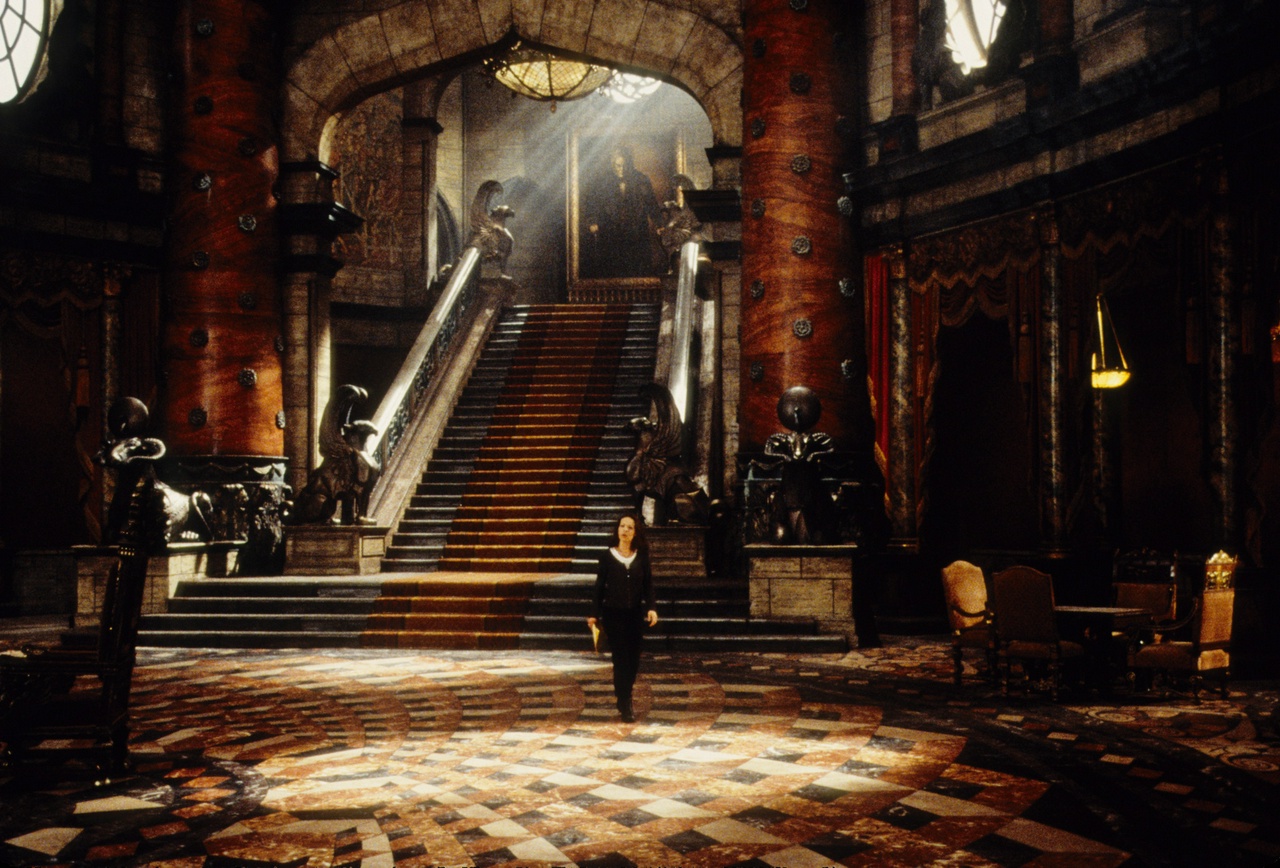
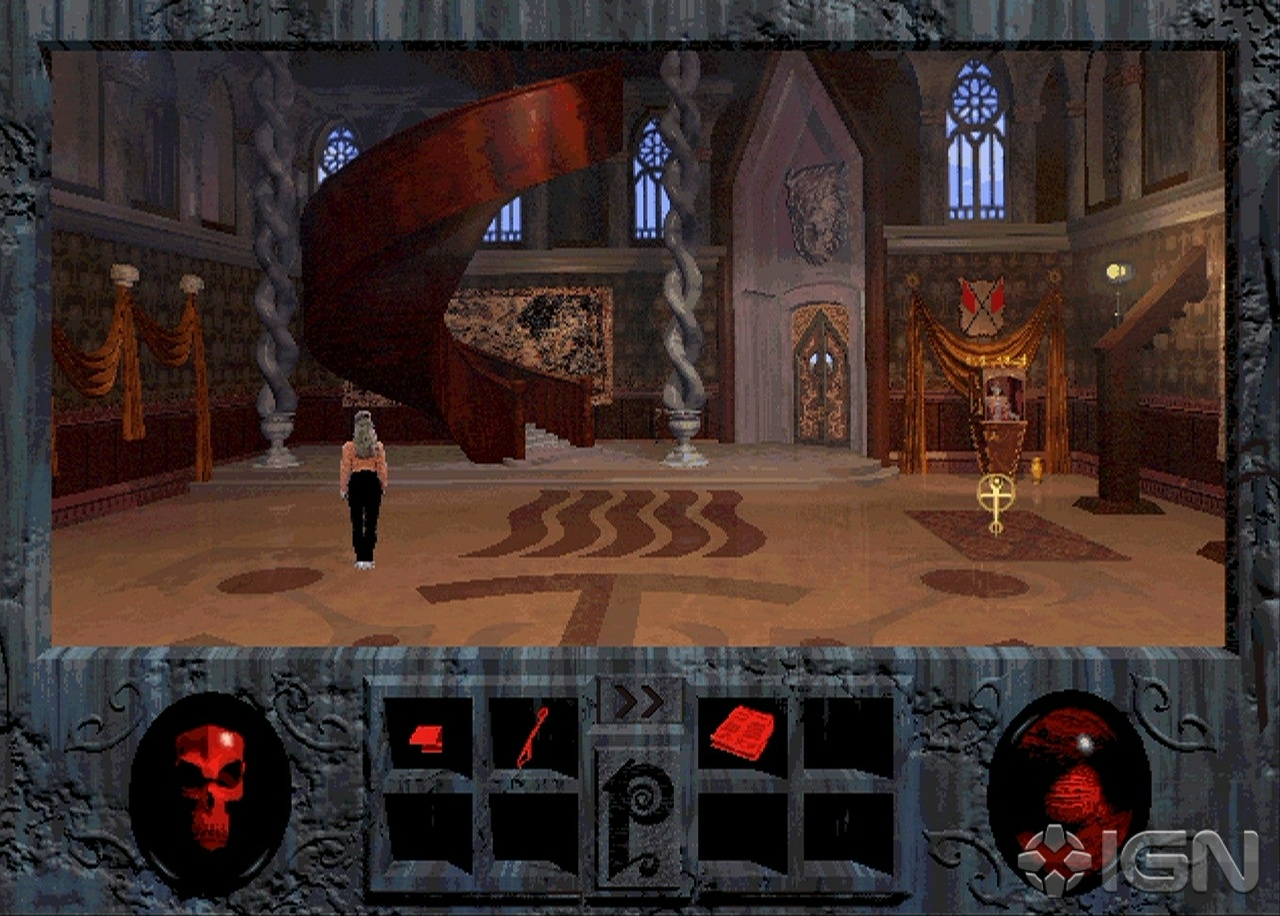
a familiar foray into a familiar foyer
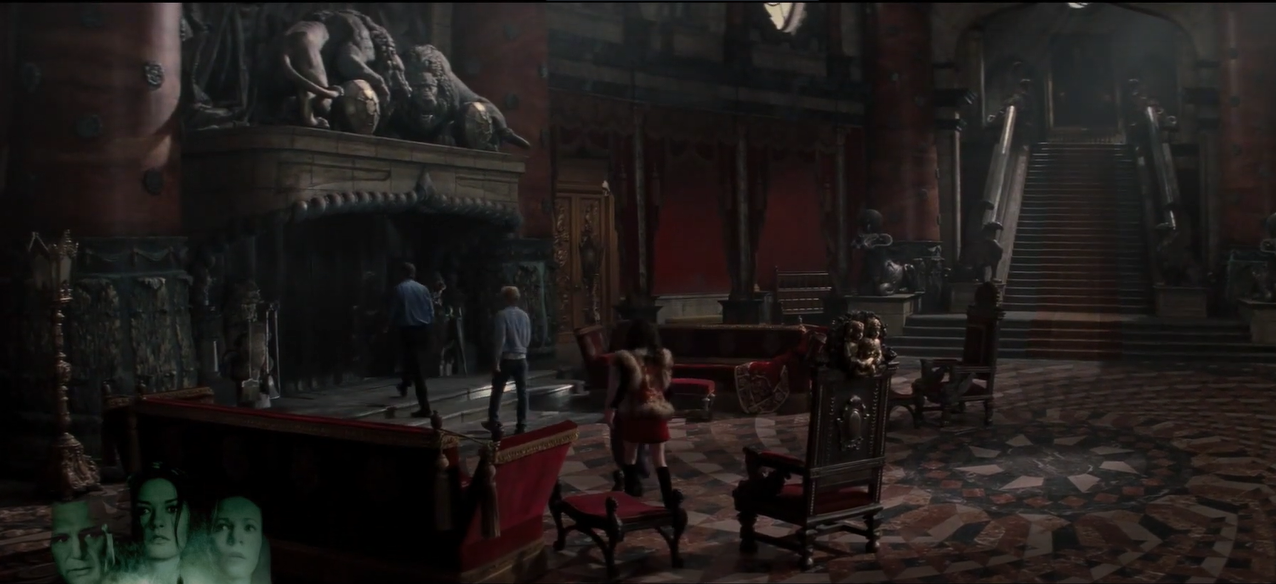
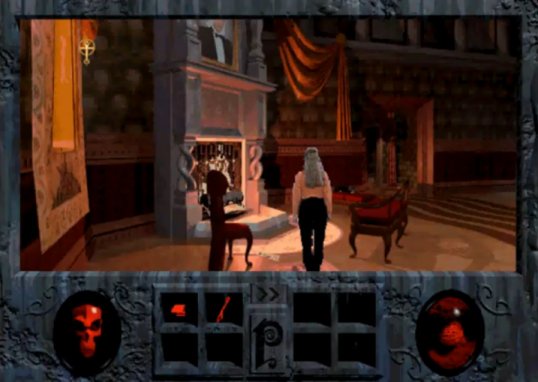
a fireplace you could get into
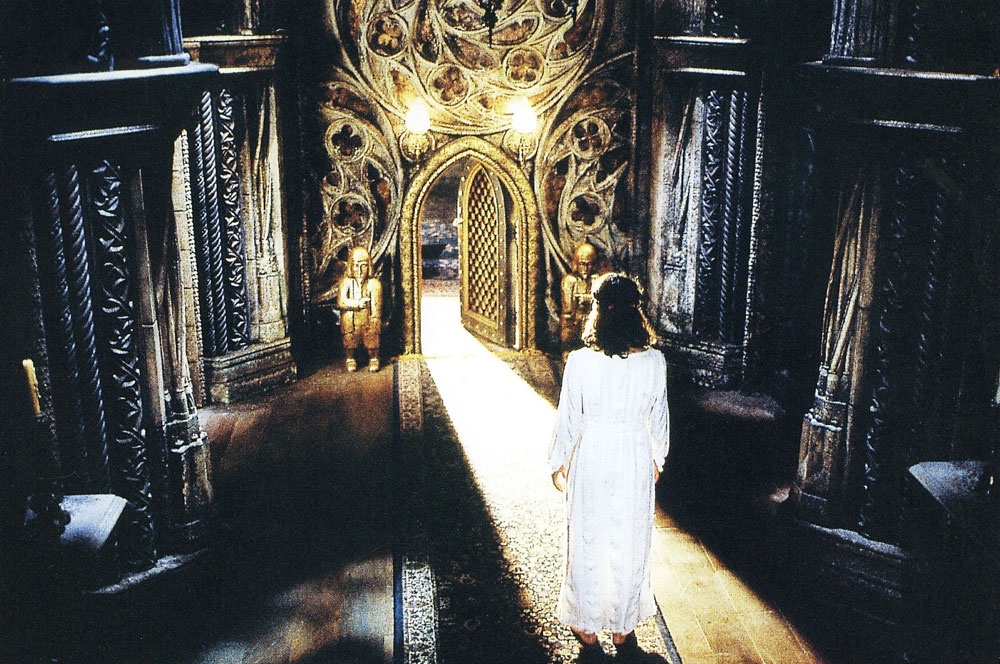
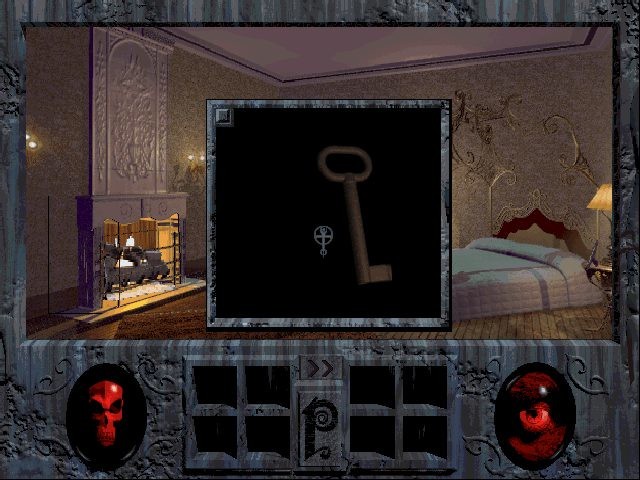
couldn’t find a readymade screenshot of the ornate locked gate from Phantasmagoria, so here’s a little key instead
Early in the interview, I asked Roberta if she thought it were "always the same house" in her games. She agreed that it was: that the house had certainly been iterated upon, had grown in size and sophistication, but that, yes, she was revisiting the house again and again, from game to game. It reminds me of the way the same house shows up in different dreams.
I explained to her that I'd recently watched a playthrough stream of Colonel's Bequest with a group of people on Twitch; the audience had loved watching Laura Bow die in increasingly dramatic and gruesome ways. It was around then, I think, that we collectively realized that Roberta had always been rewarding the player for their curiosity—not punishing the player at all. And when Roberta's heroes do die, "it's not a thinly-veiled moral parable" about the evils of curiosity or anything, I said.
"No!" Roberta exclaimed. "It's how we learn!"
At the time I had not yet read Maria Tatar's work; instead, I had been reading Adventure Games: Playing the Outsider. But Tatar asserts that Charles Perrault's rewrite of Bluebeard's wife, just like Pandora and Eve before her, is a demonization of feminine curiosity, wholly antithetical to the stories' original purpose: curiosity, mettle, is what saves her. This Uno-Reverse seems to happen a lot when oral traditions become literary canon: the moral gets swapped out, rerouted. I don't know. Something happened with the Church in maybe the 1200s.
Maybe the "punishing" nature of point-and-click adventure games has been overstated? Why are adventure game deaths so frustrating? (It's the 'retracing your steps' part—wracking your brain for where you went wrong.)
You must practice good 'save game' hygiene, creating a fresh 'checkpoint' file at every possible turn. (Contemporary games will do this for you automatically but, in so doing, strip a little bit of agency from the player, by closing doors to other narrative possibilities and avenues.) But if you maintain a certain divine apathy toward your player-character—if you regard your avatar from a clinical distance—you'll start to see their constant deaths and rebirths as charming. It's how we learn, after all.
Late in the interview I suddenly shouted, of adventure game players, "They're playing against the house! You are the house!"
Roberta replied, "I am the house."
In this way, a game designer can be seen as, simultaneously, the maze itself, as well as the minotaur in its center.
I think we design our own games around ourselves—"concentric rings of bullshit," I once called it, having just watched the movie Synecdoche, New York for the first time—unknowingly or unconsciously designing our own intricate puzzle boxes around that vulnerable, mushy, sometimes shame-filled creamy center. Maybe it's exactly like the movie Memento, except dumber. We don’t notice the rejected parts of ourselves, from childhood, building walls and hallways around our woundings as we grow up, and then—maybe at midlife, the midpoint—we have to turn around and walk right back into the haunted labyrinth we've built.
I have already discussed Bluebeard as both artist and predator, with his self-aggrandizing "colonizer spirit." I briefly touched on the idea that the wife represents a naive sort of lack of wisdom, underdeveloped intuition. She is a real "Wendy." This is to say, Bluebeard's wife's lost innocence—the painful lesson that people's intentions for one another are not always good—is the tool she needs in order to grow up, to unmake herself as a 'perfect victim' and, potentially, to protect her own children from a cycle of generational abuse at the hands of Peter Pan.
I have also written about the connection between haunted houses and body horror: in particular, how haunted houses, representing a toxic system or structure, devour and ultimately incorporate their ill-fated occupants. Perhaps the goal isn't to fully escape the structure but, rather, to fully differentiate oneself from the environment before one is subsumed by it.
These are two ways of looking at the Gothic mansion itself: as the interior psyche of either the masculine psyche or the feminine, as either Bluebeard’s or his Wife’s, as either dad issues or mom issues. (Yes, it’s a false binary! Therein lies the answer. Thinking of them as two separate things is exactly why Gothic haunted house stories all have tragic endings. These stories are haunted by archetypes—invisible ghosts of toxic gender essentialism—which address and describe emotional, spiritual, and psychological bifurcation, but fail to bridge the gap.)
During our interview I asked Roberta why her games always contain two keys—a skeleton key, and a smaller, often golden key—and she looked astonished and then murmured “we just put two keys in Colossal Cave VR...” Immediately after the interview I literally smacked my forehead; the two keys come from Bluebeard, of course. She’d literally just told me her games are always Bluebeard.
Here is what Bluebeard tells his bride, from the version I grew up with: “‘Here also is the master-key to all the rooms in the house; as for this little key, it belongs to the closet at the end of the long gallery on the ground floor. I give you free leave,’ he continued, ‘to open and do what you like with all the rest; but this little closet I forbid you to enter, or even to put the key into the lock, on any account whatever.’”
Scholars and folklorists have already discoursed the meaning of the two keys to death. The larger skeleton key is for “outside”—safe, recognizable, knowable—while the little enchanted golden key means “inside” and “danger” and “esoteric knowledge.” It always opens the door to Bluebeard’s closet, to the kernel at the center of the maze or the mansion or the puzzle box. Even in Colossal Cave VR, you can stand outside in the safety of the sunshine indefinitely, but procrastinating means the game will never start. You have to find the key to open the grate to properly enter the cave.
And as Adventure Games: Playing the Outsider discusses (and Roberta will also describe, at similar length), all adventure games are therefore based on the experience of caving—on the interior map that is plotted out, room by room and scene by scene, with one network of caves leading to the next, interconnected, as if all caves were really dungeons, or branching story plots, or neural pathways, or vestibules and arteries in the body.