metacognition
A friend of mine has recently decided to let her young son keep pet rats. She'd been reading about them, and she determined they were a more interesting choice for a pet than hamsters.
I recorded a message to her, praising this decision. In my early 20s I had pet rats. I don't anymore, only because their life expectancies are so short. Descended from lab rats, they are intentionally bred with specific health vulnerabilities and proclivities—so that if something can cause cancer, for instance, it will cause cancer.
We use rats for testing because they are physiologically more similar to humans than monkeys are. One of my favorite facts about rats is that "they know when they don't know" something. I guess it was probably discovered by behavioral scientists, running lab rats through mazes, forcing the little creatures to evaluate risk versus reward. When it comes time for a rat to make a choice in a maze, the rat might be overcome by decision paralysis. This isn't a failing; it's evidence of a higher order of thinking.
I remember being astonished when I learned this about rats, because it implies that rats are more present with their thoughts than most people are.
Another, very different friend of mine was telling me that she really admires her boyfriend's girlfriend Kate. (An unusual proportion of my friends practice ethical nonmonogamy/relationship anarchy, which is what I get for having artsy friends who live in the city.)
So when this friend feels reactive, she told me, she pauses and then contemplates, "What would Kate do?"
Then she provided examples. We were on FaceTime, where I could not hide the open amusement on my face. She saw this and looked at me quizzically.
"You've never met Kate?" I prodded. "You only know about her qualities from her boyfriend?"
My friend confirmed this as true.
I couldn't keep it inside any longer. "You're Kate!" I squealed, probably literally kicking my feet. "When you ask yourself what to do and you're appealing to a higher Kate—that's you! You're asking yourself!" I was so delighted by this, my eyes were getting wet.
My friend was surprised. What did I mean?
"The foundation of all the world's religions," I said to her, shaking my head. It's easier, or at least it is more reassuring, to think of this higher clarity as an external force. The kingdom is within you, etc.
"New Agers would call it your 'higher self,'" I explained. "In DBT it's called 'wise mind.' But what it really is, is metacognition: looking in on yourself as if from an outside perspective." It's a way of bypassing the ego and its wants.
I think I may've also brought up the Golden Shadow. That's when we admire or value qualities in other people that we've already rejected in ourselves. Those traits are, for whatever reason, quite simply not a part of our own self-definition. So we externalize those virtues onto other people instead, praising those qualities and cherishing them.
It's fine; there's nothing wrong with it. It's good, even. "Strength" is something I outsource to God since I'm not capable of it on my own. It's an external force I summon.
I just learned, from a health journalist's thread on the matter, that Kanye West took out a full-page ad publicly apologizing for his mania/psychosis. ("I am not a Nazi," he insists. A full article about it is here.)
The most interesting part of the article, to me, is where he explains he finally circumvented his anosognosia—that is, a lack of insight into one's own disease—by reading about other people's experiences on Reddit. "It’s not just me who ruins their entire life once a year," he begins.
I've read many of the same type of Reddit threads he is describing; anecdotal data shows that bipolar mania/psychosis typically occurs in autumn/wintertime. It's believed—although I'm not convinced modern medicine understands the frontal lobe all that well—that there is some sort of association with Seasonal Affective Disorder.
But this always makes me think of the cross-cultural "Wild Hunt" of folklore, a 'seasonal' spiritual battle. Wikipedia:
[Jacob] Grimm interpreted the Wild Hunt phenomenon as having pre-Christian origins, arguing that the male figure who appeared in it was a survival of folk beliefs about the god Wodan who had "lost his sociable character, his near familiar features, and assumed the aspect of a dark and dreadful power... a specter and a devil."
This is a powerful description of psychological splitting—of the shadowy subconscious taking over the driver's wheel for a spell.
Carl Jung believed (and the same thought had occurred to me independently, before I learned he said this) that psychosis is a "failed spiritual awakening." The next step is supposed to be 'integration,' but often the split deepens and widens instead.
The version of 'exorcism' I grew up with—a take-no-prisoners spiritual approach—also contributes to, and exaggerates, this psychological split. If you reject and attempt to excise your own 'demons'—which are there for a reason! to protect you and to illuminate childhood woundings!—they don't actually go away. They psychologically 'leak out.'
Kanye very famously founded his own church, perhaps to hold his own demons at bay. Of course, the pre-Christian origins of the Wild Hunt certainly suggest that psychological 'splitting' occurs with or without an institutional religion's help. It's seasonal, after all.
With most couples, partnerships, or collaborations, when one person yanks in one direction, the other person yanks equally in the opposite direction—because every body corporate, every 'entity,' naturally tries to achieve homeostasis. In this way, metacognition—"reality checking"—gets offloaded to an external party. This is a type of positive relational friction.
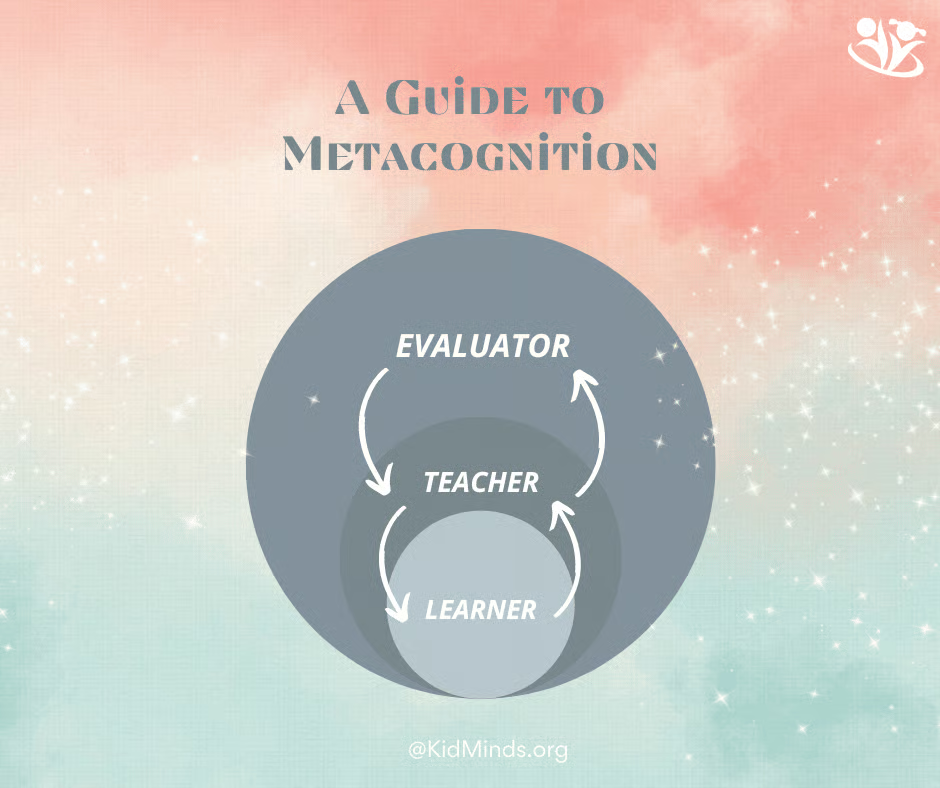
But responsible living tasks us with learning to check ourselves solo (and DBT indeed trains people to do their own reality testing). This is literally metacognition: it's recognizing that you're simultaneously the lab rat in the maze, but also the scientist, observing and evaluating the rat's behaviors.
Whether it's partnering and collaborating with a "higher self" or a "higher power," it's important to put our own Highest Kate in the driver's seat, maybe.
But what happens when someone is alone with their thoughts for too long, with no checks or balances? Worse, what happens when someone is in a frictionless echo chamber of their own design?
The New York Times recently reported on A.I.-fueled psychosis ("How Bad Are A.I. Delusions? We Asked People Treating Them"). Of two patients who had committed violent crimes in the wake of abusing ChatGPT, reports the Times, "[b]oth people developed messianic delusions about their own spiritual powers, Dr. Ferranti said." Or, as I have joked in the past—about A.I. psychosis in general, not about violence—"going the full Kanye."
For whatever reason, maybe A.I. illuminates the rift in the psyche, but it can't actually do what is required to help heal it.
Someone suggested there was some sort of rift in me—that I was so hellbent on being and doing 'good' I'd eventually and inevitably "wreck [my]self." He seemed to think that taking a long walk on the wild side would somehow cure me (and a spiritual mentor seconded it, which really curled my hair). I resisted this recommendation—I've been wild enough, historically—but I nevertheless discovered, in quick time, where a lot of my vulnerabilities were, the shape and form my shadow takes. It's leaky, that's what I concluded.
I've returned to Bluebeard several times in the meantime. I'd conceded, long ago, that I'm naive—"in the dictionary, there's a picture of you next to the word 'gullible,'" or whatever it is adults like to say to children—and that has caused me to live in denial of recognizing other people's true intentions, and probably also my own. And although I might objectively be naive, that doesn't mean I'm helpless. By allowing that there is also an inner predator or exploiter within, I free myself up to be my own guardian.
I previously wrote about the inner Bluebeard and the inner Also His Wife inside us all—the inner predator and the inner victim—while heavily citing the words of writer Gillian Valladares Castellino. She asks us to examine, for ourselves, how the ego tries to cut off our own intuition and inner-knowingness—that is to say, our metacognition, our relational awareness—by packaging it inside of a helpless shrinking victim, a "naive" maiden.
Contemporarily, we seem to use the diagnosis of autism (or ASD) as a way of explaining away 'relational naivety,' while simultaneously laying some sort of claim to higher-order thinking. Both Elon Musk and Kanye West have loudly proclaimed their autism diagnoses—as if they couldn't possibly be predatory, couldn't possibly be Bluebeard, because they are both Bluebeard's Wife, a helpless maiden who never sees the wolves coming because she Can't Even People.
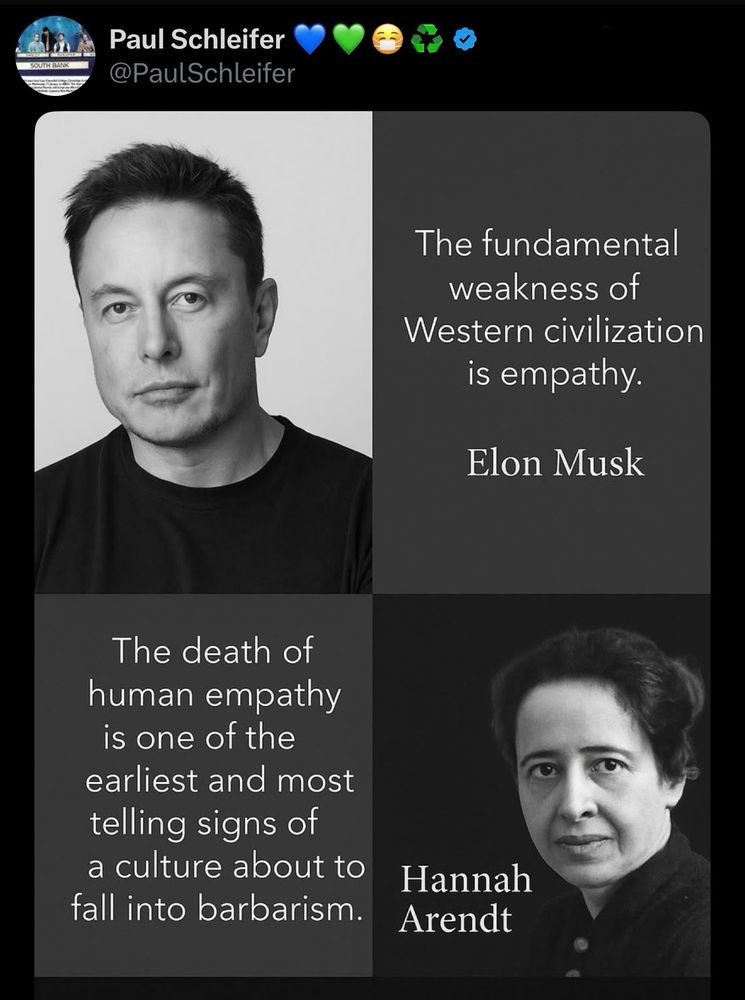
Someone recently posted this image to Bluebeardsky, juxtaposing a quote from Elon Musk—"The fundamental weakness of Western civilization is empathy"—with a much more chilling quote from Hannah Arendt. I don't know where Musk said this (perhaps on X?), or whether he said it at all, but it certainly sounds like him.
I think a lot about the antisocial traits that we attribute to narcissism. I have written, here on this blog, about barbarism in an office setting, about how 'narcissism' is probably the naked, unchecked ego's drive for survival. (Jean-Jacques Rousseau simply called this survival drive l'amour de soi, "the love of self.") In a stressful environment with an apparent scarcity of resources, every man is for himself: narcissism is seemingly contagious.
To Musk, that is a feature, not a bug. (Arendt's quote warns about the subsequent descent into Lord of the Flies chaos: societal collapse. We need widespread, fearless empathy—applied judiciously—in order to 'check' widespread narcissism. We need it for sociocultural homeostasis.)
This particular quote from Musk is very much in line with something Bluebeard would say. Bluebeard sneers at his wife's devotion, he sneers at her compassion, her 'empathy.' Bluebeard cannot respect his wife because she gives him the "benefit of the doubt." He can't understand why she would be so irrational and so stupid. Why does she think she will be the exception, "not like other wives"? He vilifies her for staying. But the above quote also reeks of gender envy: rejecting or repressing one's own traits for being 'too feminine,' then becoming furious when other people are seemingly free to express themselves. This is a violent bifurcation of the self.
In other words, Musk believes that his own fundamental weakness is empathy, but he has grandly externalized this belief onto all of "Western civilization." (We could easily derail into a discussion about Musk's plans to achieve world domination/colonization through fatherhood. It suffices to say this is just another example of his inner battle, his own internalized misogyny and self-rejection, turned into a war waged on as many women's bodies as possible.)
And anyway, the only people who would claim "empathy is a weakness" are the people who hate big-eyed weeping babies (for being 'needy' or 'manipulative') because they hate themselves as babies, because they wish they'd never been born. Obviously.
Is empathy a weakness? No, of course not—especially when the empathy is cognitive. In the hands of a well-adjusted, self-actualized person, cognitive empathy is a relational strength. Some sociopaths may in fact have high cognitive empathy, too, making them more interpersonally dangerous. Cruel mobs have also proven to have high cognitive empathy. Cognitive empathy can be mean.
What Musk hates is feeling feelings. (Inside every "fuck your feelings" is "fuck my feelings.") Compassion, grace: these are the things Musk hates feeling for others and, also, hates needing from others. He is desperate to be visible; he is terrified of being seen.
Something I am working on is continuing to have high cognitive empathy for others, but withdrawing emotional or even physiological empathy particularly when the person is soliciting empathy through triangulation. This means I can understand and have compassion for the mechanisms of trauma without buying into some wild claim of a man's perpetual victimhood.
Musk would have you believe he is a persecuted man—a bid for your empathy—even as he sneers at your stupidity for giving it to him.
appended on January 28, 2026
God damn it, I got so sidetracked by Elon Musk, I hit “publish” before I ever even got around to my real point.
There is contention over whether ‘narcissism’ as a personality disorder even exists in the real world (although it certainly exists in the DSM). Pathological toddlerhood implies developmental trauma. And as John Briere said—paraphrased by Pete Walker—if complex trauma were added to the DSM, the book would shrink to the size and length of a pamphlet.
Plenty people have developmental trauma. There’s a common belief that movie stars get ‘trapped’ at the age they first became ‘famous.’ That’s a pretty significant observation; people don’t get stuck at the age they first became happy.
I have always argued—and this has become a fairly popular stance in the intervening years—that Peter Pan is a gothic horror novel, with the title character a type of Victorian monster, like Frankenstein or Dracula. I always point to a specific scene that illustrates the tragedy of Pan’s existence:
Pan and Hook find themselves trapped on opposite sides of a huge, slick rock as the waters are rising. They are both gripping the rock and trying to climb to higher ground. Captain Hook’s grasp begins to slip. Now, Pan is obsessed with ‘sportsmanlike’ behavior—since Hook, an exaggeratedly refined figure, constantly accuses Peter of being rude and ‘not very sporting,’ which is to say, he accuses Peter of never playing fair—so Peter, chagrined, pretty regularly cedes any advantage to the grown adult. This time, Peter has the literal high ground, and Hook is slipping, so Peter gives him his hand, intending to pull him up to his level. Hook grabs Peter’s hand with his one hand, but he simultaneously plunges his hook-hand into Peter’s side. (A little obvious Jesus imagery, there.)
Peter is shocked—shocked!—that this has happened. What Peter fails to remember is that this has happened infinite times before. They are always on the rock. Peter always gets stabbed. This is how this same scenario always plays out.
Peter is trapped in a dead man’s loop, because Peter does not have the ability to learn from his own mistakes.
Psychopaths—that is, people with ‘dark tetrad’ traits—are neurologically unable to learn from other people’s stories or experiences, much less their own. Instead, they have to FAFO, sometimes suffering tragic outcomes1. To me, this is absolutely miserable, pitiable. This is a curse.
The challenge I’ve issued to myself is to constantly learn from what didn’t happen. You know how a friend or loved one nearly causes your death, and you furiously shout “we could’ve been killed!” and the person gaily replies “but we weren’t”? That shit. That’s the shit I mean: learning from all the consequences that were narrowly avoided.
Now anytime I have a ‘close call’—cutting a box open toward myself rather than away, and my hand slips but nothing goes awry—I remind myself of how things could’ve happened differently, or maybe even should’ve happened. And then and there I make a very conscious note-to-self to do it different next time.
This makes me a whole lot more grateful and appreciative for how many things haven’t gone wrong. I am in a pretty perpetual state of gratitude all day long. “There but by the grace of God go I.” It has changed how I look at every scuff, scrape, or scar.
My best friend absolutely hates when I talk about quantum timelines, but I think they’re an important part of metacognition—constantly appreciating that other versions of me were a lot less lucky—because it keeps me grateful, and it keeps me humble. It’s a God’s-eye view of myself.
Simultaneously, though, I have to appreciate that you can’t just tell people what the most probable outcomes will be. Most people have the stubborn impulse to FAFO for themselves, as is their right. Maybe you can couch it in a little parable or a my-neighbor’s-cousin story, but you can’t just tell people. Most people won’t just ‘take your word for it.’
Last night the nurse asked me if we should roll the cart of soda cans back inside. “Oh,” I said. “Because the cans are liable to explode out here overnight?”
She nodded.
“I already mentioned it. I said ‘They might explode out here’ and [friend] said nothing, so then I said ‘Guess we’ll see!’ and then she repeated ‘Guess we’ll see!’ So yeah, one or more cans will have to explode in the cold before we can actually roll the cans inside.” I admitted that it just wasn’t important enough to continue talking about.
“Guess we’ll see!” said the nurse, laughing.
"Suffering tragic outcomes" isn't a 100% given either, of course. Last September I mused that, by assuming themselves to be the perpetual 'exception' to every probability, people high in narcissism might in turn be less susceptible to pathological storytelling, a neurological rut—what TikTok has lately started referring to as "drag paths." (Simultaneously, a "drag path" is evidence that someone who is now gone was once here; recently my family showed me photos of the current-day Oregon Trail, where the grooves and pathways of wagon wheels are still very much visible in the terrain.) This would suggest that a little healthy ego is necessary for the fearlessness to "defy odds" or "go off-road."↩