my favorite animated music videos
I’m having trouble thinking of other music videos—whether animated or not—that have really stuck with me or that I periodically rewatch. I guess it’s really just this three.
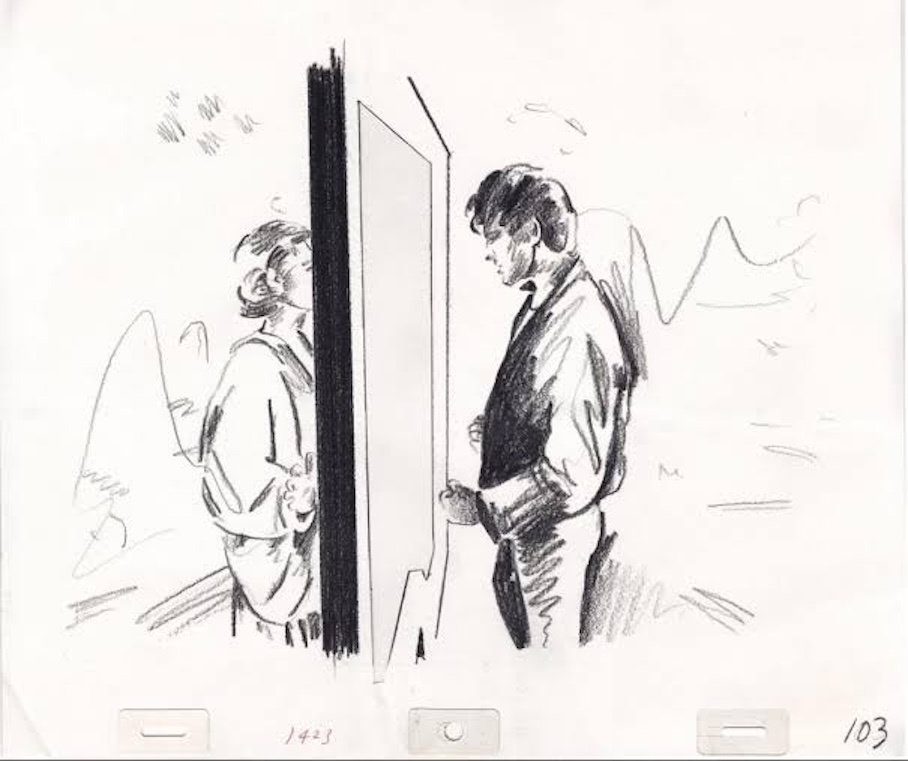
a-ha - Take On Me (1985)
One day about a year ago, my best friend’s teen son was making fun of this song. SMH. I put the music video on the big-screen TV, explaining that, to fully appreciate the song, you really need to see the music video that goes along with it, because it’s a rotoscoped flip-book.
A woman sitting in a diner crawls inside a comic book after the comic’s hero—a sketch of the lead singer of a-ha—winks at her. Tricky!! He guides her into a labyrinth of comic book panels. Stepping behind one such panel, he shows her that, in her mirror world, he’d be a real, 3D boy, not just an indistinct and appealing flattened sketch of one. (Is this music video about limerence? and the longing for something ‘real’?)
A threat emerges, a conflict ensues, and the sketch of a man tears a rip into the wall of the comic book, allowing the woman to escape to her own material reality again. Shaken, she races home, crumpled comic book in hand, to see whatever became of him. At the song’s emotional climax, she sees the sketch of a man trying to break loose from the walled-in confines of a 2D comic book panel—then, the same man in the hallway of her home, trying to escape his 2D world and fully manifest in her 3D one. Ah! Lovely, but also a little bit horrifying, a little bit spine-tingling.
“Wow, I’d had no idea!” my best friend exclaimed at the end of the very famous music video. I pointed out that, although we ourselves might not personally swoon for the lead singer of a-ha, he does have a face that inexplicably translates itself to a hot sketch of a dude very well, and we laughed.
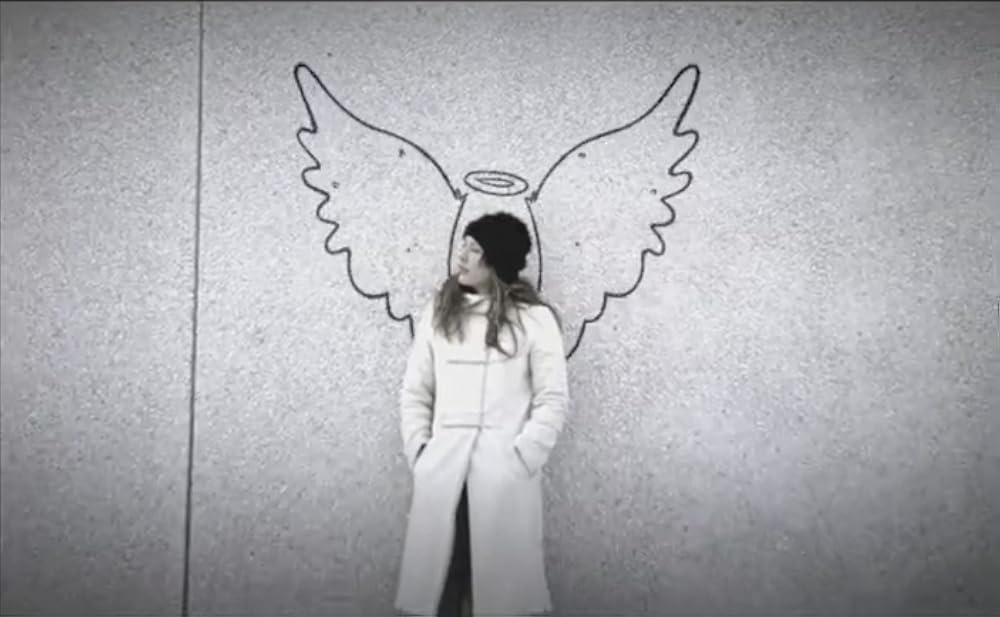
Malajube - Montréal -40° C (2007)
I don’t speak French, but this Québécoise song is about struggling to connect with others in physically isolating circumstances—literally, a difficult winter—struggling with voicelessness, with seemingly speaking a different language to those around you. Apparently the song opens with the narrator’s shocking admission that he is going through a little bit of slut phase, since he can’t afford the actual expense of a pill-popping habit. (I just learned this.)
Anyway, the music video is gorgeous, if very mid-2000s hipster-coded, with the rock band’s avatars looking like vinyl desk toys as they travel, left to right, on a sort of absurdist hero’s journey. That journey is projected onto a textured cement wall, which real human actors are standing in front of, locked in a sort of constant, detached dialogue with it. The animated drawings behind the humans function as a sort of tangible, metaphorical subtext, illuminating their inner worlds. The animators used the physical seams on the walls as lines demarcating minor shifts in perspective or scale.
By 2007 I’d taken my first (and only) desk job. Until that job I’d worked in my best friend’s store/gallery selling designer vinyl toys. I’d also, up until 2007, been a member of the Live Action Cartoonists—an interdisciplinary sequential-art theater troupe where, yeah, we interacted with animated drawings projected onto the wall behind us. (I was also in an off-on long-term relationship with a motion-graphics animator, who made stuff exactly like this. If you’ve ever watched the opening credits for the TV show Community, I guess you’ve seen his work; that was right when we were breaking up.) At that time, I was terribly homesick for Chicago, and frantic, and depressed, and embarrassed at how depressed I was, and my closest friends were all very angry with me because I’d stopped communicating with them.
So the first time I saw this music video I was like, oh, well, yeah, that’s it, that’s how it goes, that’s how it feels. Turns out I didn’t even need to speak French.
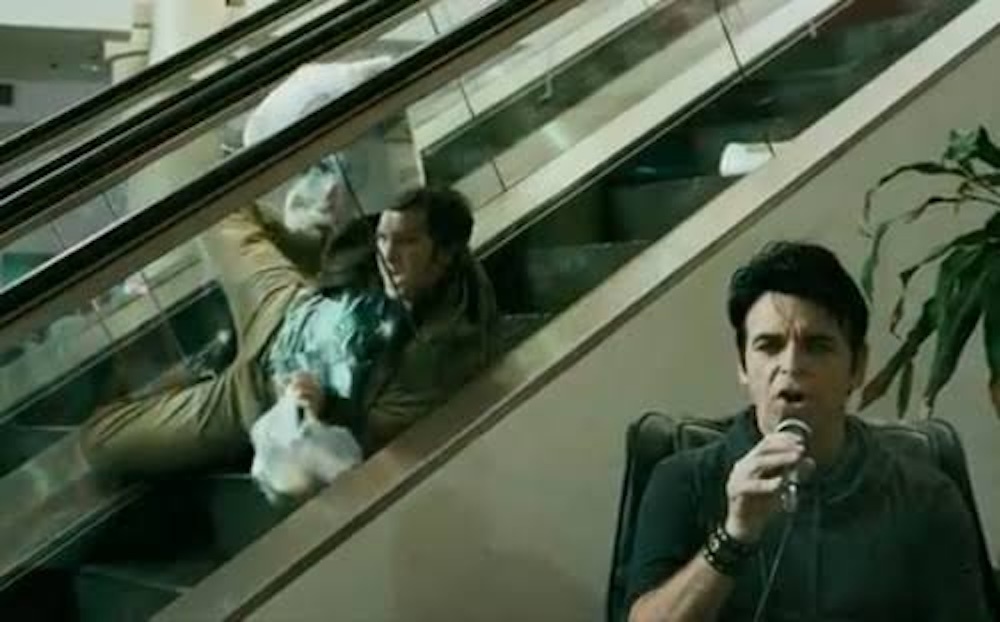
Battles - My Machines (2011)
Not obviously animated, but it is, and it’s beautifully composited, too. In “My Machines,” an overwhelmed single dad loses his kid (red shirt) and then loses his footing, and he proceeds to fall down an “up” escalator for three minutes and twenty seconds—in what would appear to be a cruel and indifferent cosmos, as narrated by Gary Numan. The glass-sided escalator has become a sort of nightmarish, humiliating fishbowl.
One of the reasons my adoptive mom went absolutely ballistic on my childhood was because, early on, she lost me on a mall escalator—it happens—and she inexplicably believed I’d been kidnapped, etc etc, and I was never allowed a fully private moment again. She must’ve felt that, if we ever got separated again, I’d die. (Being, as I was, feral, and also, mortified at having so easily gotten separated from her, I was waiting around for her next to a mall exit, anxious and bored.) Internally she must’ve felt like this single dad: terrified that a faceless Other was actively scrutinizing her parenting and basic competence. This ties into my belief that a panopticon—a constant public stage, a microscope1—makes us behave, not “better,” just that much more neurotic.
The song’s title and spartan lyrics resonate. I remember trying to make our house more minimalist—stripping down our elaborate Rube Goldberg machine of a smart home into a system that, I hoped, would work without constant tending-to or intervention, with fewer Internet of Things devices and more analog devices—and I angrily exclaimed that humans “build things to break” because we “only feel useful when we’re fixing something.” This observation, shouted in a moment of frustration, had made my husband roar with laughter because wasn’t it true? Didn’t we enjoy fiddling with the things we’d constructed? With the subconscious expectation they’d always break again—a manufactured sense of productivity? It’s the reverse of Apple’s onetime “it just works” mantra. Maybe if we had more important things to do, we’d have less patience for fiddling around.
Apparently this music video was made by the Daniels, who would go on to make Swiss Army Man (“the first fart makes you laugh…”) and Everything Everywhere All at Once. I didn’t know about this until today. Perhaps unsurprisingly, one of the Daniels is married to a stop-motion animator—she who made Marcel the Shell, actually.
Okay, thanks for reading about my three favorite animated music videos.
Obviously this video is not really about the panopticon, even though there are a couple bystanders who are, early on, startled to witness the opening pitch of this guy’s never-ending fall down the escalator. Ultimately the video is about being unable to regain your footing. “You ever drop every bag you were holding on your never-ending fall down an escalator?” Yes, thanks.
Still, though, there’s definitely an underlying theme in the music video about feeling judged, even when others around you could care less. That is to say, the belief that one is being watched, scrutinized, does not always line up with observable reality.
In the comments on YouTube, some dude wanted to know why the mom shows up at the end. And what that dude was not getting—like, it was irrationally difficult to explain this to him—is that the woman admonishing the child at the top of the escalators at the very end is just some lady. It’s the final insult for our protagonist, that a stranger has intervened, parenting someone else’s child, on his behalf. That would make anyone feel helpless and inadequate. (Curiously, the dude in the comments had also identified the red-shirted child as the protagonist’s daughter, which is… uh, I think there’s some other unexamined biases going on here.)
Then the dude wanted to know why the strange woman at the top of the escalator looks like the faceless mom (…does she?), and I was like “yeah, that’s by design, because he feels judged and everything still reminds him of his marriage.” That is, while the strange woman is meant to evoke the ghost of the ex-wife, she is not meant to be the ex-wife. This was bizarrely difficult to explain to some anonymous dude.
I don’t know. People out here are wildin’.↩