survival horror
by Caitlyn Wilson for Unsplash
content notes: stalking; coercion, unwanted contact, attrition
“I’m going to call this what it is, which is stalking,” I told my best friend.
I’d described it from the top. It had been going on far too long, and it’d pushed me well beyond my capacity. She admitted she was scared now, too.
“But here is what is bothering me, because I don’t understand it,” I said. “I’ve had a lot of stalkers?” I was trembling. What must be wrong with me?
It had started in high school, with a girl.
“I don’t know that name,” my best friend said.
“You wouldn’t,” I said. She’d attended C.H.S., a town over. We met through speech and debate. “She gave me my moonstone necklace,” I confessed. “I should not have accepted it.” We hung out once, awkwardly; it wasn’t the same as hanging out with other teens in a group. After that, she knew the way to my house, had her own car, started showing up. Long drive. No advance notice. I think I was a year younger. I was becoming afraid of this; I hid in my bedroom.
M.D. had approached me at a local tournament. “L isn’t here,” she’d said, “but she asked me to give you this.” It looked like a note, folded into a tight tidy square.
I unfolded it. It was a love poem, written in a careful scrawl with no mistakes, no scratchouts or scribbles or Wite-Out. I read the first two lines: You made me love you, you bitch / You made me want you, you whore
I quickly folded it back up.
“Did you read this?” I asked M.D.
She said she hadn’t.
“Can I ask you,” I said, “is L a lesbian?”
“No,” M.D. said. She hesitated, shifting her weight from one foot to the other. “I think she likes both,” she finally said.
This was the ‘90s, and we were children. We did not have the words.
“That is traumatic,” my best friend exclaimed.
“I’ve never told anyone because I felt so ashamed,” I said.
“And then there was your boyfriend!” She was outraged now.
I’d tried to break up with him repeatedly. Instead, he’d cried on the stoop, had refused to leave no matter how many times my parent had confronted him, had crept around the house and rapped on my bedroom window at night. It wasn’t romantic; it’d given me nightmares. I still have nightmares about my childhood bedroom, about a shadowy figure darkening the windows, rattling at them to get in. His best friend—my boyfriend’s own best friend!—had gotten a job on my university’s campus just so he could try finding me at my dorm a few times a week. I was mortified. Had I misled him in some way? Realizing I’d never fully understood this person or his intentions at all, I’d made myself scarce. After that, the boyfriend’s friend had become retaliatory.
Soon after college, there was a close friend. In another life, he’d been a missionary. Now I was the mission, the recipient of a hard sell. I’d eventually yielded. Yep! Now he was pacing around outside my retail job. I wasn’t going to make a scene at work. Outside of work, though, I’d tried to reason with him. Finally, just as gently as I could—which was very gently, for 2005—I’d asked him if he’d ever considered he might be autistic. “Because I keep trying to explain,” I said to him, “but maybe I’m being too subtle or not literal enough, because you don’t seem to understand.”
“I’m not autistic,” he eventually told me. “I understand you. I’m just acting like I don’t because it’s not what I want to hear1.” We didn’t know the word ‘boundaries’ in the early-to-mid 2000s. Also, the word we were tossing around was actually “Asperger’s,” because, again, the language has since changed. It was a devastating way for a friendship to end.
I recounted all this to my best friend. She reminded me that my next boyfriend had followed me halfway across the USA. Yes, and he’d found a novel way to get us back together: by terrorizing the guy I’d started seeing right after him. Wanting no drama, I’d taken the path of least resistance.
I hadn’t even remembered the realtor, who’d taken me around apartments until I’d found a charming brownstone, who’d started phoning to try to set up a casual date—while I was at work—often. (“I’m at work!” I hissed. “Answer me when I call you,” he snapped back.) I was horrified. I was scared to move into my new apartment, had trembled in my friend’s apartment. “What if he has his own set of keys?” I asked her in a full panic.
Now it was coming to a head. As a freelance writer, there’s no such thing as ‘unwanted’ attention, right? You should be happy for the cross-platform ‘engagement’ in your DMs? Trying to pick and choose which people and interactions you want to prioritize is entitled and unfair of you? You’re literally out here asking for it? Maybe you’re not cut out for retail, for a workplace with a big picture window where a wall should be.
I think there might be people who, understandably, very relatably, become obsessed with the feeling of being seen and perceived—who decide they want a captive audience to clap and cheer, that’s really all—but it’s starting to remind me of that creepypasta or urban legend, the one that ends with a ghost or killer shouting “so you can see me!”
Or what if it’s so much more punitive than that: “I have now perceived you, when you should’ve been making yourself so much more invisible, you silly goose, and I can’t wait to punish you for this transgression of visibility.”
“What does it all mean,” I said, slumping against the counter, gripping it to hold my body up. “How do you say no to someone you can’t say no to?” Then I folded, dropping my elbows onto the counter, my face in my hands. “What is the lesson?” I asked helplessly.
I stood there like that, propped up by the kitchen counter for at least a minute, silent, wracking my brain.
“The intrusiveness,” I said, “then the ol’ wear-em-down. That’s the whole strategy.” I uncovered my face and laughed ruefully. That’s what we’ve romanticized, right? The pursuit? That it’s supposed to be flattering? That every ‘no, please stop’ or ‘please, I’m at work’ brings the pursuer one ‘no’ closer to a maybe?
“It’s stalking lite,” I realized aloud. Diet stalking. “It keeps happening because I keep staying saying no.” My best friend blinked. “One no is enough,” I clarified. One ‘stop it’ ought to do the job. This isn’t a negotiation of territory; this isn’t a compromise. It’s what my 12-year-old frenemy had tried to get me to understand: that my pleading to be left alone was my whole problem. God, it was so simple.
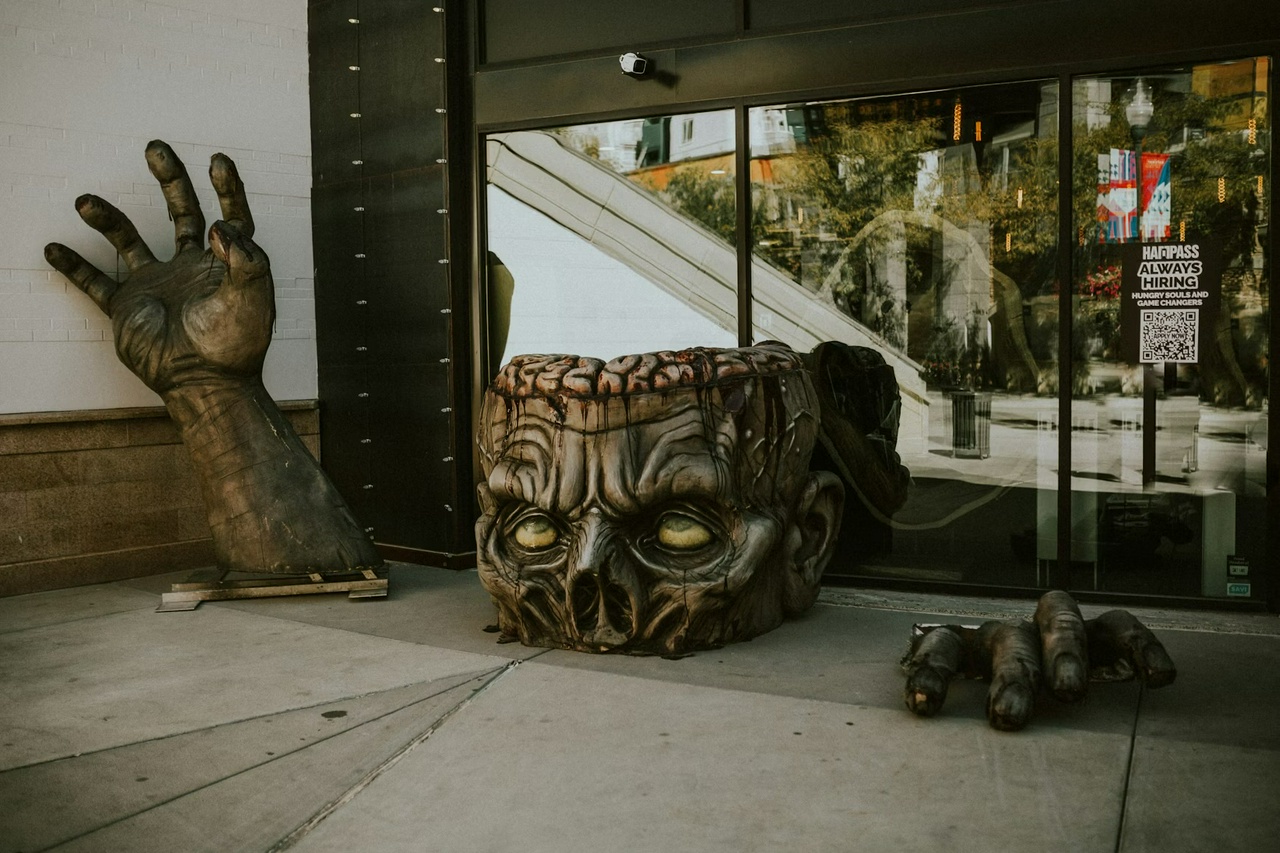
My thoughts flickered to the zombie horror genre. I get stressed out watching zombies, I completely avoid the genre, cannot get through a full movie in one sitting. It makes survival horror games hard to play. Because there’s nothing scarier than a person who cannot be reasoned with, who just keeps coming at you.
I’d had an intrusive parent. With boundaries a constant ongoing negotiation, it was always going to be a test of emotional endurance until one of us flatlined.
Well, it sure means I’ll never chase anyone down again, either—with apologies to my first-grade crush, a distinctly, comically one-sided affection. Sorry, Mark M.
Here’s something horrifying I recently learned: New research shows that many obsessive people, the types who become stalkers—the ultimate reply-guys, parasocial times a billion—genuinely believe everything is for them, believe that the object of their affection/hatred is subliminally writing, posting, or otherwise behaving, for them specifically.
This left me thinking about pareidolia: how, in the absence of complete data, we fill in the gaps, quite literally attempting to project a true picture, using our own brain A.I. to convert an image into 4K. Making a complete picture is high-level cognitive functioning; if you’ve ever been on psychedelics, you’ve seen a face flicker and melt, and you know it looks the stuff early A.I. generated, with dogs and eyeballs everywhere, lookin’ like a Biblically-accurate 5D seraphim. It’s a literal hallucination, a failure to predict and fill what goes into visual gaps correctly. (I have, as a peculiar product of hearing damage, “musical ear syndrome,” a type of pareidolia where I inexplicably hear angelic music, the most gorgeous thing I ever heard, inside of white noise, but only when I am very incredibly tired.)
When we fill in the informational gaps with our own hopes or fears, it can become a little schizoid, a little “delulu,” can become limerence—fantastical idealization, based on one’s own piecemeal construction of an ideal person—which can quickly, darkly turn into whatever the opposite of limerence is. If the real-life object disappoints, if they don’t perfectly align with the idealized internal object, they are converted into a “bad internal object.” This means the object is denigrated, and now assumes, for the obsessive person, the voice of an introject—an evil, hypercritical voice coming from inside, from the obsessive’s own mind, a type of bad programming—while continuing to wear the face of the object of affection/contempt. If that sounds like it veers toward psychosis, well, you’d be correct. It’s like an inner demon wearing someone else’s face. That is too much for the object/target, who is a real human in real life, to be up against. That is why stalking is so frightening.
But then I started thinking about all the times we have incomplete data and, given to pareidolia, we fill in the gaps and are absolutely correct, permitted that all cognitive resources are freed up for it and allocated to it. This looks like a sort of supernatural intuition, when it is really more like a sort of high-level multifactor pattern recognition.
I was thinking about this because I’m better than most at lipreading, maybe jarringly so. Well, it requires a certain attunement to the subject. But one evening I’d briefly lost the ability to lipread after drinking a single Pabst tallboy. It was then that I realized that, all along, I’d been filling in data gaps without consciously noticing, and that drinking a beer throws me out of attunement entirely. Which is why drinking a beer feels great, socially, when you tend toward over-attunement and over-functioning, but it’s absolutely disastrous when you’re the only one in the room who can ordinarily read lips.
Perhaps what over-empathy is, then, is using ourselves to fill in the informational gaps: an overextension, a hyperextension, producing microtears in the ligaments and tissues and joints, a movement beyond what is considered normal range, which isn’t really noticeable or observable—rather, it is taken for granted—until there is severe injury, or maybe some accumulation of catastrophic damage to the self, like being told you need a left hip replacement at age 40 because the damage is beyond reparable.
This is really a footnote, though, about denial, about people who throw out information because they just don’t like the information: a manufactured delusion because we have issues with cognitive dissonance, even when that dissonance is entirely internally produced. So when you tell someone ‘no’ and they ignore you, they are potentially creating their own data gap, filling in your ‘no’ with their hopeful or angry ‘maybe’. When you give them even more information—maybe an accidental firehosing, rather than clarity—you are offering up more material for them to punch holes into, to manufacture their own picture.
This gives me pause, because I have to now consider all the times people told me to my face how they felt about something, and I thought to myself “well, that can’t be right, because a normal, healthy person would never say that.” Yeah, well.↩