war, what is it good for?
This blog post took a week to write. It’s not the longest thing ever, but it could be shorter.
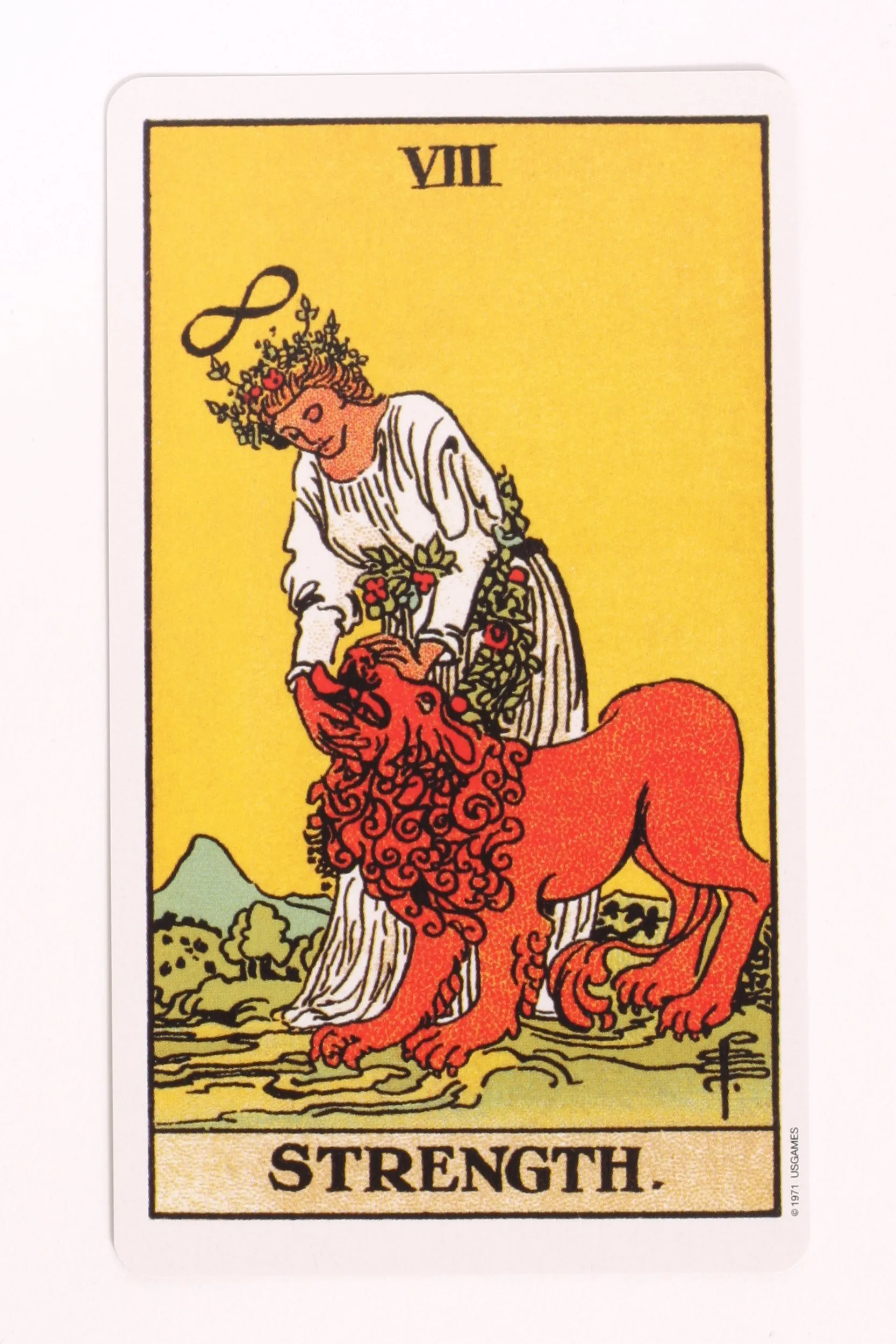
After overthinking my necklace possibilities, I’d put on my Strength Tarot card pendant for going-out. “La Force,” the small brass rectangle reads.
The RWS Tarot traditionally depicts Strength as a white woman in white robes who is using both her hands to hold open the maw of a lion. It’s about the sustained tension of equilibrium, with her own applied force exactly equal to that of the lion’s jaws. There is no conflict here; the woman’s face is placid and contemplative, meditative, almost smiling, as the lion gazes up at her. Perhaps she is attempting to administer medicine to the animal. A lemniscate hovers above the woman’s head1.
A short while later, wearing my Strength necklace at the bookstore bar, I was saying something about gladiatorial combat. “That’s what it’s for: people clamoring for blood, satiating an audience’s bloodlust2 without anyone actually getting killed,” I blurted.
“That’s not, uh,” my artist friend said. “Someone dies, in gladiatorial combat.”
“Yeah,” I said, frowning, “sorry. I meant theater in general. The origins of theater. You know, staged tragedy in lieu of actual slaughter.” A simulacrum of death and destruction, perhaps in hopes of preventing the real thing. To drown the stage with tears, to cleave the general ear with horrid speech3.
Now I was walking my artist friend back to their dormitory when we both froze in floodlights. We whirled in place, looking around, blinded and a bit dazed.
We turned and stared up at the illuminated wall behind us. Projected onto the wall’s blank brick surface was the outline of two figures in opposition, their arms stretched out toward each other, hands clamped on forearms.
Someone called out to us from a distance—since we were, of course, standing in his way. I waved, and we approached the muralist and his assistant. Now that the sun had fully set, the muralist explained, he was about to begin painting the side of the building. It is the new, permanent location of a dance studio and arts nonprofit.
My artist friend immediately began giving suggestions about how to make the image more dynamic, to make the tension of the scene much tauter. They suggested that the two subjects be less lateral, more diagonally opposed—that the angle of the line itself be intensified. Now my friend was running up to the brick wall to point, shouting their suggestions, moving their hands around. Their words were far away, distant and echoey.
“They’re a well-known sculptor,” I explained in a low voice apologetically. “And also a professor.” I was trying to explain their critical overzealousness to the muralist, but perhaps I was making things much more painful for the muralist instead. “We can’t hear you!” I called out to my artist friend now. I looked back at the muralist, who seemed deflated, maybe startled, definitely dour, verging on seething.
I’d been good-copping all night, so why stop now? “I do love this idea of tension, though,” I was saying to the muralist, “of equal force being applied in two directions.” Equal and opposite force, push and pull, a sustained dramatic moment, a suspended homeostasis.
“I like that it could be a fight, but they could be in love,” the muralist’s assistant said to me, nodding.
Ah, yes, the two genders: love and war. “Yes, either way you cut it, they are grappling with each other passionately,” I said, of the two outlines.
“That’s interesting,” I said out loud, acknowledging a thought I’d not yet verbalized. I turned to face the two. “Do you know,” I continued, “when I was 20, I was dating the graphic designer at the Joffrey Ballet. The company was about to stage Romeo and Juliet. Up until then, the Joffrey bus posters had been like ‘50 of Chicago’s best athletes every night’ or whatever. And I was like, oh my god you guys, this messaging is so alienating. You don’t need to try to attract sports fans to the ballet. The ballet already has fans. They already know the athleticism involved in dance, they don’t need to be convinced of it.”
The Joffrey had wanted youthful, contemporary, appealing, spectacle. The spectacle of sports! The then-ongoing ad campaign had been something like ballet dancers leaping around in basketball jerseys, or football or baseball costumes, something obscene like that. Honestly I don’t really remember, except that I’d intensely disliked it. It’d felt like a men’s rebrand of moist towelettes—trying to Dude Wipe ballet.
That was why, I told my boyfriend and his boss, they should pivot and lean into what theater actually offers its fans: murder. And romance! And tragedy!
I suggested the phrase “Love! Passion! Murder! Nightly!” or some such permutation—maybe romance violence murder nightly, or maybe love tragedy murder nightly, actually I think it was that last one—along with a pair of blood-spattered toe shoes, abandoned in a little pool of blood. Yes! Bloodshed! On stage, every night! It’s a Joffrey guarantee!
Sasha and his boss Herb loved it. They decided to use my full idea, unadapted. I watched them photograph pale pink toe shoes, spattered with some sort of dye, inside a shock-white light box. (A fan of sfx makeup, I might’ve even told Sasha what kind of stage blood to splurge on—a bottle of liquid ruby-tinted Ben Nye—but it’s much more likely he discovered it on his own.) I was very impressed with their production values. Then they did the actual graphic design part, multiple layouts, different dimensions. It looked great.
Their advertisement went up everywhere, all over downtown Chicago—with me its uncredited architect. Herb suggested that Sasha bring his girlfriend around anytime. (That had made me anxious, actually, since my idea was so obvious, so archetypal, could be used for any ol’ Shakespearean tragedy, etc., I wasn’t sure how I was to be expected to ever have a second idea.)
“Interestingly,” I was telling the muralist in present-tense, “they had to redesign everything again, for the postcards. It had been determined by the ballet’s board that you could not send this apparently controversial, violent imagery into season ticketholders’ homes uninvited.”
The muralist and his assistant were appropriately stunned. Yep! The insinuation of violence out in the public square? Fine. In plain view is A-OK. But on a postcard? Sent directly to older, paying members with steady incomes and stately suburban houses? Absolutely not. That’s not consensual; that is an ambush, a crossed line, maybe even a type of trauma-dumping. The disrespect!
My artist friend had returned, having trudged across the enormous empty lot, a bit frustrated with us.
“I almost wonder if there are other ways to introduce tension without making drastic changes,” I murmured now, holding my chin. The two figures were evenly matched, although maybe not on equal footing. “Maybe if the one with better leverage were a tiny bit leaner,” I suggested, a potential on-the-fly edit, “and the one on the defensive had a little more bulk.” The muralist and I gazed out at the wall thoughtfully.
Now I was admiring the way the scene had been framed out with squiggles of foliage, forming an organic proscenium over the scene. “Bringing in the landscape so the mural becomes part of the horizon,” I murmured to myself, nodding. “Hey. What’s happening down there in the bottom left?” I gestured, wax-on, at a kind of trypophobia-inducing mass.
“That’s a third person, the observer. They’ll be kind of silhouetted,” he explained.
“Oh! I didn’t even see him!” I frowned. “Now I do. There’s the head and shoulders, I see him now. But I actually meant all those little circles,” I said.
“That’s the, like, the light,” he said.
“Ah, sundappling,” I breathed.
“Exactly!” he said, turning toward me and beaming.
“That’s very interesting, though, about a shadowy third figure rising up in the corner,” I said. “Do you know the Karpman… uh, Drama Triangle?” Usually I call it the conflict triangle, because it is about the way people view conflict, the way we authentically feel about being drawn into conflict. But it is actually about the theater of conflict, about the roles we are casting, the roles others give us: our own embittered battle to always look and feel like the good guy.
It’s the model all publicly staged conflict follows. Three roles. “Victim, oppressor, and observer,” I explained now, pointing at each of the three figures. “That third party is a witness. They can be the judge and jury, they can be rescuer or hero, they might even be a journalist or filmmaker.” I smiled at the muralist. “Obviously, at the ballet, that figure would represent the audience itself.” He smiled warmly and nodded.
As we left the muralist to his work and hustled away, my artist friend could not conceal their hurt and indignation at having their valuable critique ignored.
“Well I think he’s literally about to start painting,” I said, trying to not laugh.
I’ve been reading Mutual Aid by Dean Spade4. (I’d been reaching for the book The Serviceberry, intending to buy it for my best friend; I ended up buying both books.) Now I was talking to a friend about her dramatic battle to save her alma mater from certain doom. I was flipping through the book while we talked, looking for Good Ideas.
I was pensive. “I think I am being called to remember how fun it can be to stage a conflict,” I said to her.
I’d been considering what a silly, happy time Twitter had been, with many of us, all friends, taking opposite sides of a debate and just picking on each other ideologically: “the Discourse.” And this is a public service, because if you and a friend are heatedly debating every angle or facet of an argument, you are effectively explaining a current event for any onlookers. It’s your industry’s version of McLaughlin Group on PBS5. And this is a good-faith performance of indignation, because presumably no one is actually getting hurt.
Once Twitter had started to balloon and conflict could be monetized as ‘engagement’, though, the debates themselves had started being about genuine life-and-death stuff. Strangers were dogpiling, sea-lioning, astroturfing. “Debate me, bro.” “Just asking questions.” “Change my mind.” Instead of friendly, curious conflict that had been staged to read as fierce6, this was bitter, dangerous conflict, staged to sound friendly and reasonable (er, sometimes). We all wanted out.
Ever since, I’d lost my competitive drive, my orneriness. Constant interpersonal triangulation—that is, everyday conflict, constant debate seemingly being staged for an unseen audience, “it’s too late, I’ve already depicted you as the Soyjak and me as the Chad”—had worn me out, maybe forever worn-out. Trying to negotiate every need, or defend or debate every logical boundary, had sapped the last of my strength. It seemed I’d been permanently trapped in daycare hell, cast in performance after performance unwittingly7, always reacting, always engaging: unable to discern real conflict from its facsimile. August never ends.
Now I was telling my dietitian about my chat window. I was anxious about two people, one of whom has lately been picking a fight8 with the other, and who now seems to be building up a little army of online allies. It has been giving me a nervous stomach. I do not want to get swept up in this. I will not pick sides in service of someone using bystanders just to make a self-righteous point in public. I was already exhausted.
“You’re a peacemaker9,” my dietitian said to me sadly—for the third time in as many weeks.
“About that,” I said to her. “I think I’m being called to remember the value of staged conflict10.” I tapped my face thoughtfully.
I told my dietitian about my good friend Dara, who’d abruptly started bullying me in ninth grade. At first I was confused. Then I’d laughed, had sparred with her a little, was very sad about it, had enjoyed it sometimes. Infuriatingly for her, I’d refused to take the bullying too personally11.
“She apologized later,” I continued. “And I mean, she didn’t have to. I understood. I was a goody-two-shoes”—or I was perceived as one, at least, since my mother had taken a job at the high school explicitly to surveil me—“and Dara had wanted to distance herself from that.” I shrugged. We were on the same side, and that side was mom issues. We both longed for private lives. But my presence undermined Dara’s attempts to appall her own mom, because moms love me, what can I say. So I’d colluded. Later, after high school, she’d apologized. She didn’t have to; I was already in on it. If it meant I could stay in her life, I hadn’t minded being her prop.
Anyway, late in high school we’d started staging conflicts just to curl other people’s hair, play-fighting just for the sheer gremlin joy of it. “It was only upsetting when people actually took sides,” I admitted to my dietitian now.
I recently saw a TikTok of picketing nurses attempting to return to work and an officer turning them away from the hospital doors. The well-organized group begins to chant. Of course, all of it, including the police officer’s conversation with the “chair of the bargaining committee”—captured on video for all of social media to witness—is part of the demonstration.
“This is so staged,” someone wrote. “They were reading the script.” In retrospect, I guess the commenter meant the cop sounded scripted, that he actually read from the hospital’s statement or the order he’d received or whatever.
“I mean, yeah?” I replied, because both parties sounded scripted. “Staged conflict attracts attention to their cause and message. A hospital is an entity, an institution made from the body corporate, and you can only engage with it as another ‘entity’—a union, a mob, whatever. The conflict is staged to demonstrate [to an audience] what the nurses are asking for from their workplace.”
Maybe most battles are invisible to others until a simulacrum, a performance of the conflict, is publicly staged, and then it becomes visible. Maybe storytelling is what makes the apparition manifest itself.
The cop did sort of agree to mediate, probably wanting to look agreeable or even heroic on camera—promising the spokesperson he would head inside, would tell hospital admin that the employees were ready to negotiate—“but his job is to serve and protect the hospital itself, not the people who work for it or who are for-profit patients inside it. One institution protects another,” I wrote. How do I put this? I’d thought the cop played his role well. A little more salt and vitriol12 might’ve played even better on camera but, you know what, I’m generally on the side of deescalation. No notes.
“You empower the nurses’ cause,” I continued, “if only algorithmically, just by watching, by commenting. It’s really the only system we have.” To attract attention and hopefully, eventually, enact change, I mean.
The person to whom I was replying ‘liked’ my comment, so I guess we were on the same page.
It does feel weird to cognitively land there, speaking as a relative casualty of a terror campaign that liked to reframe itself as a consumer-rights movement. Still, GamerGate proved that corporations will yield, cave, or bargain with a clamoring mob of seeming terrifying size.
“One thing quickly became apparent,” I wrote in March, of the aforementioned mob. “We may collectively be in the thrall of billion-dollar corporations, but corporations, in turn, will absolutely defer to a mob’s will.”
Unions work, that’s all I’m really saying.
A few nights ago a good friend texted me a screenshot, without comment, of Chicago’s current AQI. I admitted I’d never even seen such a number.
In turn, I talked about West Hollywood’s crumbling infrastructure, the street collapsing early that morning. It’s a warning shot, I said: the pipes are not to be ignored. “Ignore this issue at your peril. Like, the crumbling pipes are now speaking for themselves.”
“As are the burning skies,” my friend replied.
“Damn that’s beautiful,” I texted. “You know, in a messed-up way.”
“CivilWarLand in Bad Decline,” my friend suggested.
They said something about reactionary politics—joking that I could’ve already done an ideological flip, “why I’m leaving the left,” and returned to my home team by now, could’ve made big bucks along the way. Funny.
I said that “reactionary” was an apt word that works on a lot of levels. Reactive, reactivity, reactions. Maybe it suggests that always-on-the-defensive politics are a sort of long-term trauma response, a nervous system firing off.
My mom had taken video games away from me, so I got into reviewing video games mainly to annoy her. And if everything you are doing is a reaction to authoritarian control, then the authority is still controlling you; it’s just opposite day, an empty rebellion. If nothing else, you’re helping the authoritarian. You’re helping them make a triangle.
Putting up a good fight, which might mean moving unpredictably, requires getting yourself together and not just reacting to an authoritarian, because that authoritarian is reverse-psychologying you into doing the thing they want every time. That’s how you get hoovered into energy-wasting triangulation, rather than picking and choosing which conflicts you’d willingly stage for an audience—that is, which battles are really worth fighting13.
footnote hell
So which figure is supposed to represent Strength? Is Strength the female figure, or is it perhaps the lion beside her? The lemniscate holds the clue: “strength” is made up of both figures put together.↩
“Something I always found humiliating about my 23andMe data,” I whispered to my best childhood friend, “is that I’m apparently more neanderthal than most people.” Much more.
“Me too!” she exclaimed. Her data had come from Ancestry, but she’d learned the same thing about herself. Oh, the shame.
“It turns out,” I said, “that our idea of neanderthals is probably all wrong. They probably made art and poetry.” I sighed. “Easier to take over,” I said meaningfully, rolling my eyes. Yep! Our pacifist ancestors were probably conquered.
“Oh my god,” she said.
I don’t know. Something about art, poetry, peace-making. What if bloodlust—aggression—is generational? I have it, too, of course; we all do. We all write long fantasy narratives about evildoers getting their just comeuppance. Especially since you cannot actually go around meting out vigilante justice yourself, as this would erode the fabric of society.
Suppose neanderthals cleverly invented art in order to pacify their oppressors—running interference by offering up a decoy, a simulacrum of violence, a cave painting—like Scheherazade amusing her captor, or a court jester and his mad king. Obviously I’m just joking around; that isn’t what happened, probably.↩
“Rosa Parks was a professional activist,” my artist friend had suddenly blurted. I’d gasped. I put my head down, tenting my hands like a visor over my eyes, and I stared at the wooden counter in front of me. “She was asked to participate. Did she want to make a real difference,” my artist friend continued. “So to pretend like she was just this lady who randomly wouldn’t give up her seat on the bus diminishes her legacy as a strategic, seasoned activist—”
“I was cast!” I whispered in amused horror. Tears were springing to my eyes. “The filmmaker asked me how I felt about being called a hero,” I explained to my artist friend in a low hiss, “about people’s memory of me present behind the scenes, constantly trying to help.” This was yet another role I’d instinctively rejected. “I said, I don’t know how helpful I was really being. I said, that sounds a lot like meddling to me. I said that being helpful is what people do when they themselves feel helpless. I said this pointed to an inability to look inward and tend to myself. I told the filmmaker I take a much darker view of it now, this drive to be helpful—that it isn’t altruistic at all, it’s self-aggrandizing, it’s interference, it’s control issues.”
After a long pause the filmmaker had said: There is no reason for you to say any of that in my film. I laughed now, recounting this, just as I’d laughed at the time. (“Sure, OK,” I’d said, snorting and putting up my hands in surrender. And she’s right, of course. The layers of scrupulosity OCD—what is genuine? what is fake?—are not really meant for consumption by a casual audience wanting a moral and a verdict. It’s fine. Everything is fine.)
But I’d been cast the first time around, too, hadn’t I—drawn into a staged conflict, one that became bigger and bigger—and I couldn’t swing it back then, either, could not bear this massive responsibility of being scrutinized. I had too much shame to hold up under scrutiny.
At one point I’d been offended by another target’s own political ambitions, thinking it all a very dirty business—shameless, even. I don’t want to undersell the harassment she experienced, the very real threats to her life and livelihood, and I’m still very grateful that she’d thrown herself into the line of fire, running interference (though her reasons for doing so were not, interpersonally speaking, altruistic). “Now I think this was a failure of imagination,” I said to the filmmaker. On my part, I meant. She stared at me.
“Oh,” the filmmaker finally said, “I didn’t understand what you were saying at first.” Yep. Yet another failure to launch.
My artist friend’s remarks about Rosa Parks had finally, and a little bit brutally, snapped reality into view: I’d been cast a second time, this time as a potential hero rather than as a victim or perpetrator, and this time I’d even signed off on it. Which means I’m legally obligated to stick with it this time around, to stand up to scrutiny. Sure, OK.↩
From author Dean Spade’s new preface:
But Shouldn’t the Government Provide for People?
One of the most frequent questions I have been asked since Mutual Aid was published is “doesn’t mutual aid let the state off the hook?” This question comes from a desire to see government care programs expanded. Many people are rightfully angry, being taxed for war and police while basic necessities are cut. They resent having to provide care that they believe should be part of state provision.
This question reveals a faith in the possibility of a caring state that I do not share.
Spade goes on to describe a welfare state that sorts people into ‘deserving’ and ‘undeserving’:
Relief programs […] are designed to provide not lasting support but rather as little as possible to keep people mostly quiet while maintaining desperation that will make people willing to take any job at any wage. Anti-racist, anti-colonial, feminist, and disability justice movements and scholars have consistently demonstrated that care programs are just another face of the colonial project […] and cultivate pacified and exploitable life for the nation.
The fantasy of a caregiving state is understandable. We live under such thorough control that it is easy to want the very systems that control us to become caring and cultivate survival. It may even be hard to imagine how else we could get what we need, if not through state provision. However, this fantasy is a significant obstacle to our resistance movements, causing us to misunderstand the conditions we live in and the tactics needed to transform them. Many people use the term “abandonment” (sometimes referring to the work of abolitionist geographer Ruth Wilson Gilmore) […]. This terminology demonstrates the confusion I am referring to. It suggests the state is a kind parent who has turned away from some of its flock and that we want it to turn its attention and care back.
“Daddy issues,” I said, reading aloud from the book to my best childhood friend (who is a small-government libertarian who, simultaneously, believes in better food labeling and transparency, and who is against corporatocracy and the privatization of various government limbs, etc etc, and also, the libertarians around me are increasingly pro-regulation, if you can believe it, ho ho). Yep! We’re always projecting our wants and needs onto a giant system that has its own unconscious wants and needs already, irrespective of our own. An entity cannot love us, cannot care about us, perhaps cannot even work for us. My best friend nodded, wide-eyed. Yeah! I knew she’d be into this. What a way to motivate libertarians to help anarchists with their shared cause! Good going, Dean.
Later, I’d float the same paragraphs to my friend who is organizing fellow alumni. She wasn’t too sure about what she was hearing. “I don’t know that I believe that,” she said carefully, or something like.
“I know, I’m of two minds,” I said, nodding. Because it sounds like potentially giving up on changing a system—content to be locked in eternal battle with it instead—all in favor of demonstration, of making a point about how no system can ever be your friend (or father).
Maybe my issues are too deeply embedded even after Dean Spade has explained that wanting to put faith in a pro-social government is just daddy issues in disguise. But I also have matching mommy issues. I remember how jealous, even wrathful, my mom felt toward my unwavering love for my dad, so she’d frame him up, set him up to fail, endangering my life just to show me that my dad was unstable, unreliable. And I think jeopardizing a child’s life just to make a point to the child is incredibly imbalanced: interpersonal triangulation to maybe a psychopathic degree.
So yes, I understand that my dad was unreliable and that I’m susceptible to working out my own issues using big government as a stand-in—a common mistake to make, as typified by MAGA referring to the U.S. president as “Daddy”—but I also worry that Dean Spade sounds like my mom here.↩
One of my happiest memories is, two decades ago, planting myself onto a couch with Ed and Mike to watch McLaughlin Group. It was a show I used to watch with my adoptive dad. It turned out they’d watched it with their own dads, too. Ah! Was there ever a safer feeling than listening to two boys shouting about current events. These were the two safest boys I ever knew. I’d go out to the bar—the youngest person in every setting, for a little while—and seek the two of them out, planting myself near them, a type of phototropism.
Very similarly, there was a moment (at the final-ever XOXOfest) where my friends Phil and Shawn were facing each other, shouting at each other—in one accord, in agreement, really giving each other the gas, both men’s blood pumping, lion-hearted, bringing themselves to a rolling boil—with me, their one audience member. I was watching them closely and not entirely listening. Rather, I was basking, standing rosy-cheeked in the glow of their self-righteous passion, heated up from the inside like a microwave, feeling very safely ensconced. My two dads. It’s sad that this feeling is so, so rare.↩
On the topic of playful, pugilistic dad energy, I recently watched an old clip from the Phil Donahue Show. It felt like a warm dinner party. But this was on social media, where not everybody was a huge fan, in retrospect, of Donahue’s particular interview style.
“He’s a great interviewer,” I commented, replying to someone, probably a Gen Xer, who was sad about the chilly reception the deceased Donahue was receiving. “I really didn’t understand till now. His questions are well-researched, and his play-fighting is the perfect foil” to let his interview subjects shine, I suggested. I didn’t say so explicitly, but being a foil is usually demeaning, a type of women’s work. (Similarly, no one wanted to play opposite Kathy Bates in Misery.)
“He’s empathetic and silly,” I continued, of Donahue—observing that he constantly challenges his subjects just so they can haul off and verbally kick the shit out of him, and look good doing it, too. It’s a type of collab. “I think we just aren’t used to this playfulness and familiarity anymore,” I wrote. “I’m not defending teasing or bullying, but I think we’ve lost the gentle art of play-battle.”
“You’re so right,” the maybe-Gen-Xer replied a few days later. “He often played devil’s advocate, usually with a sense of humor. The questions we used to find compelling are now found offensive. I don’t understand why people have become so sensitive.”
Hm. I couldn’t help but remember Piers Morgan’s icky line of questioning for Condoleezza Rice: repeatedly asking her why she was single and wouldn’t she like to date a football player. It was an ambush, a betrayal of trust between interviewer and subject. Rice gracefully deflected, over and over, but the whole thing was a horror show. Piers Morgan is why.
I replied to the maybe-Gen-Xer. I thanked her for her reply, adding that I’d continued to think about Donahue for a few days. “I think it has to do with Twitter and the monetization of ‘engagement’,” I replied. “I think it’s because of so many of us being baited into bad-faith discussions.” And chatbots and botnets, I added. Really, it’s just the erosion of goodwill, of trust. We were a higher-trust society in the ‘80s and ‘90s, I wrote. People aren’t too sensitive; they’re rightfully on guard.↩
“You kept getting beaten down and never had a chance to get up again,” my best friend said to me recently—something I’d once said of myself decades ago, but no one had ever said to me. I don’t know. Maybe my best childhood friend just tells me what I’d like to hear sometimes.
Worse, I keep telling people the most likely reason they do the things they do—like an LLM would, all psychology and empathy and sycophancy and pattern-recognition and predictive text—and I keep handing them reasons for their own behavior, “that just sounds like ADHD to me,” “that’s relational trauma,” unwittingly handing people pieces of costuming, of armor, to put on. Because I can’t believe in a flat, 2D person. So I start fleshing them out! I’m giving them their character, their props, their motivation. Jennifer, you fool! A third of people don’t have real motivations! A full third just wants to look like the Chad! They think everyone else is performing, too! Stop being their Soyjak! Stop casting them! So that they’ll stop reverse-casting you! You fool!
“Consciousness is a performance,” my artist friend had exclaimed in the bar, exasperated with me. I gasped and laughed. I knew they didn’t want to know what I am always thinking about—that there is only ever this present moment, that as far as any of us know we were just suddenly beamed in, that our personal histories and traumas and grudges are only things we think we know about ourselves, a cover story for why we are the way we are, as if we were all replicants in a sci-fi horror story—because we all need ‘character motivation’, a bit of believable business, an external force, to motor us all the way across the stage floor. Like, that’s just the logical end of simulation theory.
So I just smiled at my friend instead, shaking my head in delight and disbelief.
“I think they really do think of themselves as the villain,” a mutual friend of ours mused aloud later, of the temperamental artist, and I laughed.
“That’s a story they tell themselves so they can move through the world with confidence and authority,” I said to her. And ownership of their ambition, I think I added.
At first I’d only been a little irritated. We’d been walking in circles. “Like, are you about to murder me,” I’d asked, huffing through a pitch-black alley, utterly unable to see. My artist friend assured me yes, and that they could get my whole body into a kiln. “I dunno,” I said, “I think I’d be stuck half-in, like Pooh Bear trying to get inside Rabbit’s house.” They assured me it would be far easier than I was envisioning: it’s a really big kiln. “Okay, that’s all I ask,” I said. (I tried to describe visual snow later which, in the dark, had made it impossible to see where to put my foot.)
But the artist friend had very forcefully wanted me to jaywalk with them, had dragged me forward, had walked ahead and stood on the curb and yelled—had stranded me in the middle of the street multiple times. By now I was ready to leave.
“I don’t want to engage with other people, or their cars,” I’d called out to them from a cement median island, desperate to make them understand. I don’t derive any sense of agency or power from walking out in front of cars, forcing drivers to brake for me—quite the opposite!!—and I certainly didn’t love being stranded in the dead center of five lanes of moving traffic. I shouldn’t have to repeatedly attempt to negotiate why I don’t want this—I should have said “I’ve had enough now” and turned back, acutely aware my friend would never have kept goading anyone they respected—but, instead, I’d flipped out and shouted something from my own personal history, a sort of sharp verbal attack.
I immediately regretted this, regretted yelling, because it’s just giving other people a full map of the territory, X marks the wound, a bullethole other people can gaily finger later, a button to push to get whatever they want out of an exhausted vending machine.
And how could this person feel safe with me ever again? They’d never seen me upset before. Instead of embodying safe, calm Zaddy energy, instead of saying “I’m not doing this, so here is where I leave you,” instead of letting myself be cast as a villain or maybe a coward, I’d yelled. I’d dysregulated, I’d overshared, I’d become an unfit mother. JFC having friends is hard.
Anyway, yes, consciousness is a performance—and what’s more believable onstage than a person who really, really believes what they’re saying? That’s how you get drawn into conflict with someone performing outrage, someone trying to win. And you can’t tell real and fake apart anymore, because it’s all somaticized in your body the same way, felt as true. If the universe is here to feel itself, an electrical signal radiating through the nervous system, then whew, you’re definitely God’s favorite.
I’ve said this with such quick certainty, as if the body itself didn’t have its own special ways of telling real from fake, counterfeit from genuine. Harder, probably, is telling fantasy from fantasy.
Maybe existing in the world is like looking down at a 6-year old on the floor and seriously asking oneself is this crisis or tantrum. I was recently confronted with such a dilemma. I squatted like Meloni or D’Onofrio poking a crime scene with a ballpoint pen. “Hmmm,” I said to the child, inspecting her face for tears. (None! And I’ve seen a wounded ego generate plenty.) “And where is the injury,” I asked her. She pointed. Having myself grown up without any siblings, I’ve had to learn to appreciate that the child engages in bits of strategic theater, like a cat, if it means her older brother will be apprehended and punished: “That’s the man, officer.”
This has pushed me to consider whether triangulation—the performance of injury, ploys for pity, like a limping dog wanting the lap of its parent, the drama!!—is something pack animals emerge from the wound (typo) already doing, having grown up with attentive, fretful parents who can and do intervene. A child of neglect, I only cry when I can’t communicate and feel like popping, or else I cry in secret. Or I guess that’s all changed, but it used to be true.
Then, too, there is the fact that, for a relatively trauma-free 6-year old, every fresh insult or frustration is the worst thing that has ever happened to her. I try not to laugh. I hug her a lot.
For the traumatized, neglected adult child, two things are simultaneously true: we are ‘younger’ than our peers (socially stunted, slow to understand that ‘regular’ people are still playing daycare games by daycare rules), and ‘older’ (very few American millennials had, until now, experienced any tribulation more severe than constant financial indignation and humiliation, plus some medical trauma). I’ve always overemphasized others’ emotional landscapes while criminalizing my own feelings. But I think I had it right as a kid after all: laughing at others’ distress, recognizing it’s usually not that deep. This too shall pass. That isn’t sociopathy or antipathy at all; that’s a sense of proportion.
I also tend to laugh in relief. And I start cringe-smiling when people describe terrible things. I also smile when I’m incredibly angry, which looks ghastly. I guess my face is never doing the right thing.↩
I’d already pointed out to my friend that there’s nothing she can do ‘right’ in this scenario, because the person in question is really only trying to resolve or alleviate their own cognitive dissonance. Now I was describing the acquaintance’s internal conflict to my dietitian. “Congrats,” I muttered, “that’s just the cognitive dissonance of having a job.” To relieve it, the acquaintance is projecting and externalizing an inner villain, agitating for a big fight, saber-rattling. I groaned. My interest in someone else staging a conflict for their own ego’s sake is just at absolute zero.
I’m depleted, bored, and filled with dread. My least favorite feeling! Tired bored dread!↩
When my dietitian says “you’re a peacemaker” that often, it’s beginning to feel like she’s really trying to call me conflict-avoidant.
TikTok recently confronted me with a sort of astrological mad-lib: if your moon sign is this, fill in this word. If your rising sign is that, fill in that word. My sentence ended up reading “I coddle in order to avoid depth.”
I was astonished and possibly devastated. There are other old ladies—moms!!!—whom I’d certainly indict of this, but never myself. I stared at this mad-lib sentence for a long time, contemplating how true it might be. Am I dodging conflict, and potential connection and depth, by rushing to coddle others instead? Telling them “ah, that’s understandable,” rather than allowing others’ words and actions speak plainly for themselves? Rather than holding others accountable? Throwing my own nervous system on the altar of their dumb bullshit?
One of my artist friends—a sculptor who builds with physical materials and their own two hands, who doesn’t think of anything as real if they can’t reach out and touch it—does not give a single shit about why anyone does anything. (“It’s really not about you, it’s about her mom,” I’d told them of another person with whom they’d experienced conflict. “It doesn’t matter!” they’d shouted back, all hopped up.) All that matters to them is the action itself, its effect, no excuses, no grace. Listen, I get it: you can’t see into someone’s heart anyway. That’s valid.
And I mean, of course I agree. I’ve even said the same to a friend in the past—because, as a narrative designer herself, she keeps trying to solve the mystery of others’ behaviors, their motivations—when the onus is not on her to solve other people, to puzzle over them like locked-room mystery boxes.
So what’s with all the grace? What if it turns out that some people are 2D, flatter than poorly-written prose. I’m not calling anyone an NPC; I’m saying that many people have lost themselves, that they desperately need repossession. Or maybe some people have never experienced something approaching grief and loss, perhaps fall apart under the slightest stress, like rain-soaked cardboard. (I’ve joked that, if I ever were to write fictional characters based on certain actual people, I’d have to do the thankless, grueling work of psychologically re-humanizing them, fleshing them out for readability and believability, using myself, my own experiences, to fill in the gaps—making them more sympathetic, so that the page isn’t crawling with not-believable cardboard cutouts. That’s great, for writing fiction. I’m trying to learn how to stop fleshing people out in real life.)
These people are dangerous to be around, too, because they will, in turn, flatten you: managing you, wanting you digestible, panicking anytime you break a script, dividing you up into little pieces. Unflattening yourself, getting yourself back together, is painful and crazy-making, the insane experience of being reborn—twisting and screaming in the forceps’ jaws before your brain has even had a chance to start wiring itself.↩
The 1985 movie Legend of Billie Jean was filmed in the city next to my hometown. Our high school U.S. history teacher had played a news reporter in the movie—a bit of trivia he never let us forget.
I recently read a retrospective of the movie, and I was startled by a few different revelations. For one, the movie’s lead, Helen Slater—who also played Supergirl—has, as of one year ago, just finished her doctorate in mythology. Another shock: Billie Jean Davy was loosely based on Indian politician (and “Bandit Queen”) Phoolan Devi. (Not for nothing, but the name “Devi” itself has an even greater implied resonance.)
Then there’s the actual title: the movie was originally set to be called Legend, but for the Ridley Scott film of the same name. That’s because Billie Jean is about how something relatively minor—a disagreement, an altercation, a threat, an outstanding debt—can quickly snowball into something much bigger and weirder, a Katamari, a sticky ball or projection space for other people’s hopes and fears and anxieties, a planetary body with its own field of gravity.
In many ways the character of Billie Jean is flattened by her own clamoring audience; in other ways, the idea of Billie Jean becomes too big for one person to contain, an egregore that contains pieces of all the people who ‘believe’ in her, who remake her into the utility they need, who simultaneously rally around her and yet are wholly oblivious to what she’s actually asking for. It’s similar to the way a saint’s life gets conflated and enmeshed with a preexisting archetype. (To that, Billie Jean might contain shades of the documentary series Love Has Won: the Cult of Mother God. “They killed her!” I gasped as I watched this series about a demented woman and her demented followers. Man, there is nothing scarier than a fan club.)
So Billie Jean handles interesting themes, and it’s also kind of disturbing, even though everyone does live through it (as far as I can remember). It’s also been many, many years since I watched it. I told my best friend that I’d like to watch it with her now—and that I kind of wish I’d watched it before doing an interview about GamerGate, since there are maybe certain insights I wish I’d been carrying in with me at the time. Oh, well.↩
That’s the real trick: not taking things too personally.
I was recently talking to a shuttle driver, the first of two, about outsiders moving into the region. He tensed up when I identified myself as one such outsider—but as I continued talking, I think it became increasingly clear that I’m transient and from nowhere, a moving data point rather than a fixed one, and he seemed to relax.
“When we first moved to Austin,” I told him sadly, “we moved into a highrise building, not realizing how much everyone hated that building. But the city is landlocked and people keep moving in, so you can really only build upward now. The building changed the horizon, the skyline. Actually, it blocked the view of the Capitol building,” I said, smirking. “Now there are so many highrises, you’d never be able to pick out which one made people so mad. But ours was the first, with all that represents to people.”
I trailed off, thinking. All this outrage over a handful of women and enbies having Patreons in 2014—when everyone and their dog have a Substack now. But ours were the first, with all that represents, which was an unwelcome, emotional change to the city skyline. I sighed, staring out the window.
Anyway, our highrise wasn’t even the first. We were actually preempted by a condo building that, at the time, Alex Jones lived in.↩
What, pray, is “salt and vitriol”? I’m pretty sure I meant “piss and vinegar.”↩
I’m a big believer in Ephesians 6:12, which directs us away from relational or interpersonal agonism and, instead, toward reckoning with the dark patterns, sick systems, and institutions by which we are all harmed.↩