Widow’s Bay 108: clear and present danger
CN: massive spoilers; also waaaay longer than intended but I’ve been sitting on these thoughts all week long; also, a potentially weird read
invisible threat
Generally I do not listen to podcasts at all, but these days I am in the car more often, for longer. On Friday I’d listened to Spotify’s Prestige TV podcast for the first time; Caro had messaged me a link to the podcast’s episode 8 recap a day earlier, and I’d discovered I had plenty of opportunity to listen in the car. (I also had thoughts1.)
Yesterday afternoon I came home, switched out of my platform sandals and into my comfy sandals, and texted Caro. I explained I’d just listened to the episodes 6 & 7 recap, also from inside my car.
Caro was delighted. “I was gonna email them tonight and mention your thoughts re: The Shining (about colonialism) and how I think the Big Bad is some kind of ancient spirit, but that it’s like it’s a manifestation of fear—” they wrote,
“DO EET,” I replied, thrilled. The podcast’s hosts select listeners’ emails to read on air: fan theories, insider details, that sort of thing.
“—and it doesn’t have to be like a specific god or demon but something primordial, e.g. it’s all of our fears. ‘Cos imagine in the past—ofc in the early 1700s you’d fear a plague. You’d fear a ship disappearing. In the modern age, you’d fear a male serial killer, or a series of them.”
“I think that’s fabulous,” I replied approvingly.
Last week, after watching episodes 106 & 107, I’d suggested to Caro that the Great Evil haunting Widow’s Bay could be thought of as “the cloud,” in a digital data storage sense, like iCloud or Dropbox. And the things that manifest out of this cloud2 are highly individualized, personalized horrors—“like Ray and the Stay-Puft Marshmallow Man,” I suggested to Caro, since everything is Ghostbusters3 to me, “choose and perish”—using, as building materials, the stories and beliefs, the old wives’ tales, that people retain in their subconscious and conscious awareness.
“Well, and here’s what I was thinking about in the car,” I continued now, building on Caro’s insights about the anxieties defining each era. “The whole show is about dark patterns4. The same dark patterns that make it hard to opt out of a website—”
“Oh girl you know this is my expertise,” Caro replied, since it quite literally is their field of expertise.
“—or hard to opt out of your family’s ‘but this is how we’ve always done things5.’ And wetiko is another dark pattern—so dark, the person who has it doesn’t even know they have it.” That is, it’s a dark pattern in the psychological sense.
“Yessss,” Caro replied.
Stefano Pollio 2017
“I was just sitting down to write about this,” I continued, “because episode 108 is so satisfying now that Patricia can point to a material evil6, can point directly at an actual person or event and go ‘it killed all these people and slashed Bechir, just ask anyone.’”
The dark pattern is supposed to stay invisible, I continued; “that’s why that one TV critic’s review in TIME Magazine ticked me off.”
Well, it had ticked all of us off. At 12:01pm on May 21 I’d pasted, into our group text, a link to the TIME review of Widow’s Bay.
“do y’all wanna see some shit,” I prefaced. “this review made me hit the roof.” Then I pasted the hyperlink. Then: “imagine the point of everything being this invisible to a tv reviewer.”
Caro had replied first:
“I am having such a visceral reaction to this review in the waiting room that [Husband] just asked if I’m okay.”
I’d chortled out loud at my desk, feeling a strange sense of relief. “I flew into a very mild rage last night,” I agreed, “when I was supposed to be going to bed.”
Caro remarked that the reviewer’s primary beef—that the show is “all references” to other pieces of media—was weird.
It’s inverting tropes, Caro wrote.
Now I was activated, fully in a huff. “People are so self-satisfied about picking out leitmotifs in a pastiche that they kind of… like, are you watching though,” I replied, heated. “I’ve seen, on social media, lists of ‘horror references in Widow’s Bay,’ and it’s startling because it’s like… duh…”
I thought about it for a split second. “Honestly, okay,” I typed, regrouping my thoughts. “I hated the first season of Stranger Things. Moody and enjoyable as it was, THAT felt like a trope remix with parts unchanged. I have very bristling feelings about authorship and ‘fair use’ and I LOVE when someone runs a baton in an unexpected direction, and I BRISTLE when someone eats a reference, shits it out again, and goes ‘it’s mine now because I’m the one who pooped it out.’ Like, well, you actually added nothing and made it worse, so.” People will really spit out a derivative work, a poorly-duplicated facsimile of the original, and try to sell it as superior to the source material. Nah, bro.
That’s why the Judy Berman review in TIME Magazine is so surprising and so startling, I continued. She claims Widow’s Bay is just a pile of references with nothing to say. “And I’m just like, ‘uh. You seem to be reviewing Stranger Things,’” I concluded.
final girl
I’d live-texted my thoughts to Caro while watching episode 108, “Your Baggage.”
I began by saying I enjoy how “lean and mean” the show is—“expediency,” I texted. Short lines of dialogue do insane lifting, like ants carrying bread. Scenes end in a blink, cutting straight to the next location without any fiddling around in the car.
I paused and scrubbed the episode backward, just to confirm that Patricia had fully pulled her house’s front door shut before walking outside to tend to her bus’s blaring alarm. Patricia doesn’t notice, of course, that she is walking back inside through a left-wide-open front door.
In “Your Baggage,” that’s the last mistake Patricia ever makes. She almost immediately clocks that she is no longer home alone, and she responds accordingly. If you’d ever previously doubted Patricia’s witness account, or that she’s utterly traumatized as a person, you can kiss those misgivings bye. Patricia is beyond vigilant, hypervigilant, even: she has been training all her life7 for this do-over8. Her survivor’s instincts kick in.
As Patricia crept out of the house and waited in the street, stun gun in hand, for her stalker to appear, I noted to Caro that Patricia was perfect—an absolutely perfect survivor9.
She breaks into a run. On this mad dash, Patricia’s first stop is Ponytail’s house—to warn her, since all the other 40-year-old women are sure to be prime targets. Ponytail’s house is warmly lit, filled with women drinking wine. As the scene opens, Ponytail’s girlypop book club is discussing the 2002 novel The Lovely Bones.
Ponytail is making an incredibly off-key observation about the book—a fundamental misunderstanding of, not even subtext, but the book’s actual text—while her friends react with horror. Either Ponytail never read the book up to its murder scene, or she’s just a sociopath. (Either way, “she’s the worst, she’s the fucking worst, I’m—I’m sorry.”)
I’ve never read or watched The Lovely Bones, but I do know enough about it offhand to know that it’s narrated by a dead teen girl, now witnessing the aftermath of her own murder. I pointed this out to Caro immediately.
Apparently this teen is 14-year-old Susie, who has a whole tasklist of shit to finish before she can move out of Limbo and fully pass on. She does briefly possess and embody her classmate Ruth (?), enabling Susie to experience her first kiss, which is… nice, I suppose.
The plot follows a girl who was murdered and watches over her family from heaven. She is torn between seeking vengeance on her killer and allowing her family to heal.
Right up until this point, Patricia has been a ghost herself—a living one, with as much voice and personal efficacy as one of Ponytail’s murdered friends (who Ponytail enjoys speaking on behalf of, a lot).
Patricia makes a pretty big scene before abandoning the book club. Now she watches Ponytail’s windows from outside, squinting to see whether the threat to her peers has passed. Nope, the threat is coming after Patricia again. She breaks into another sprint.
In Widow’s Bay, up until this marathon chase scene, Patricia’s own internal world—shaped by her hopes and dreams and fears and traumas and experiences—has never been witnessed, has never been included in a sort of… collective, shared understanding of real reality. As a result, she is utterly isolated, unable to share a sense of community reality with others.
Adding insult to injury, everyone keeps trying to assist Patricia’s pursuer, offering aid to the downed serial killer, which, you know, is why resolution can take so long in real life, is why a person has to keep running, keep striving. Like, the predator keeps being restored to full health! Stop! (Patricia frantically yells for people to stop helping, which of course has the opposite effect she intends—and the chase resumes.)
Even though the sheriff, Bechir, is a clear-sighted guy who attempts to come to Patricia’s rescue, there is something sharply observed here about how third parties, when joining a two-party conflict, have a tendency to read every room wrong.
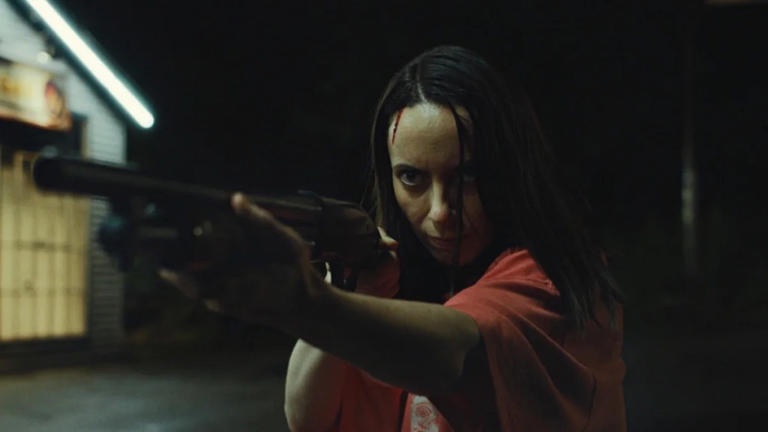
The awesome thing about a major catastrophe is, it removes all doubt. The traumatized individual, numb after experiencing years of social or interpersonal pressure, is finally like, holy fucking shit, I can’t believe I ever mistrusted myself, I had it right all along, I always knew the truth but I still went along with your whole shitty thing instead.
“The deeply troubling thing about gaslighting is that it works,” writes Dr. Ingrid Clayton in her self-help book Fawning. “It’s effective in robbing someone of their truth and their ability to trust themselves.” She continues,
When it comes to fawning, gaslighting actively encourages someone to see harmful situations as harmless. It tricks them into soaking up all the shame. Gaslighting solidifies a fawner’s avoidance. It endorses self-abandonment and appeasement, propping these coping strategies up. Gaslighting deepens the split in the victim’s psyche between the one who knows the truth and the one who has to take responsibility to survive it.
“Appeasement” brings to mind Patricia’s handwritten note to the living corpse of Richard Warren (Are you angry at something I said?). This is what pop psychology might refer to as “self-abandoning behavior.”
Dr. Clayton continues,
Self-gaslighting is when we internalize these manipulations (or lack of protection from them) and begin to gaslight ourselves. For me, it sounded like:
- “Maybe it wasn’t that bad.”
- “I didn’t experience ‘real’ trauma.”
- “He didn’t mean what I thought he meant.”
- “I should be over this by now.”
Even as a psychologist herself, Clayton writes, she “still couldn’t believe or reconcile my own traumatic past. It was like a ghost that haunted me […].
The first social worker I spoke to in my childhood […] said, “Emotional abuse isn’t a reportable situation.” In my developing brain, I learned that the problem wasn’t going to be resolved out there, so it must reside in me. This resulted in a storm of emotions, including anxiety, depression, confusion, and shame. But even my symptoms felt like impostors, because they weren’t related to anything “real.” So I kept telling myself I shouldn’t be feeling them at all.
…One of the insidious things about gaslighting and self-gaslighting is their invisible nature. It makes them hard to identify. I remember wishing I had bruises as a child. I thought, Maybe the social worker would have listened then.
Today, if someone said to me, “I don’t believe you. You are a liar. You made the whole thing up,” I would be appalled, and rightfully so. I can’t imagine any scenario where I’d say that to another human being, and I will not keep saying it to myself. Self-gaslighting solves our cognitive dissonance, but it leaves us holding the bag. And this is the real kicker. We lie to ourselves. We believe we can’t be trusted.
“Fawning is taught, encouraged, and expected in so many contexts, which is why we can miss it as a trauma response and why we can think it is just our personality,” Clayton writes. The version of Patricia who tases Kris (“Ponytail”) is the real Patricia. She isn’t pleading her case to Ponytail anymore. Instead, Patricia does what someone probably should’ve done a long time ago.
Sure, Patricia’s true, innate personality is still violently weird; she was socially ostracized before a serial killer chased her. People are punished by the dominant, prevailing group for any outward differences all the time. Like, that’s a total thing. We aren’t all born effortlessly likable10.
Fawning flourishes and is perpetuated because it’s bigger than one person’s body or coping mechanism. It is ignited in us, then, through a feedback loop, becomes amplified and rewarded in the world. Our sense of self becomes distorted not just through personal adaptation, but because systems of oppression accelerate this process of change, moving us further away from our inherent state.
You can see that Dr. Clayton’s book isn’t only about “fawning” anymore; similarly, Widow’s Bay isn’t only about ghosts and curses and pacts. (We hope and pray that any given TV critic would say “well, duh,” but that’s obviously not a given.)
I guess that’s just how horror works, though. You start with a narrative template—some sort of looping narrative, a cycle—and then a ‘final girl’ comes along and breaks the mold. You start with a genre convention, and then you break it. Or you don’t, and the horrors continue, and we’re all doomed.
timeghosts
Widow’s Bay is ultimately a time-travel story. A lot of viewers have pointed out, in fan forums, that time is moving wonkily there. I don’t find that too strange, though, since time can move weird in real life, too.
But it’s very literally a time-travel story, in that Richard Warren is literally a time-traveler—here he is, emerging from a sarcophagus 300 years later, like Ellen Ripley awakening from cryogenic slumber—and the Boogeyman is a time-traveler, and the curse itself is a time traveler11.

Rodrigo Gonzales 2020
I struggled with episode 106 because of its tone and themes. But I do not totally hate a ‘lore drop’—especially since, if we take a quantum view of the flow of time, everything might be happening simultaneously. If so, the 1700s are just as ‘present’ and ‘alive’ as the 2020s.
This is why waiting around for old white guys to die is never the answer to society’s ills. “We’ll just wait for this guy to die, and then the curse will be broken, and we’ll rebuild our whole government and society.” Well, no. That’s just one pitiful guy down, which doesn’t do anything. Look, Gen Z are wryly referred to as “Zoomers” because they behave suspiciously like Baby Boomers. Waiting for Boomers to die off isn’t how we enact change. Inherited patterns don’t just fizzle out.
Something I started thinking about a handful of years ago, as I lit a candle for a deceased family member, was how the flow of time is meant to work, here. I mean, presumably I was lighting a candle for this family member’s emotional and psychological healing in the afterlife—or maybe in limbo or purgatory, if I believed in such things12. But I’d idly started to wonder if, somehow, from here in the future, I could improve my relatives’ lives in the past.
If I did—if I healed their traumas from here, in what seems, to me, the present—would my own life markedly improve in some way? Except I wouldn’t be aware of the improvement, because my memory would obviously update along with the change?
Anyway, I think Widow’s Bay will have something to do with that. Hopefully it doesn’t literally turn into the movie Frequency, about dead dads and abandoned sons—and I don’t see how it would, since it’s already a Lovecraftian folk horror genre mashup—but also, like, this wouldn’t be the worst thing that ever happened. (Frequency has the corniest, cringiest ending I’ve ever seen in a mainstream movie. It’s great otherwise, though!)
generational curse
Episode 108, “Your Baggage,” ends up right where it belongs: what legacies are we comfortable with our descendants inheriting? Tom Loftis imagines a brighter future for his son, going so far as to suggest to Evan that they visit colleges over the weekend. I think I audibly sniffled.
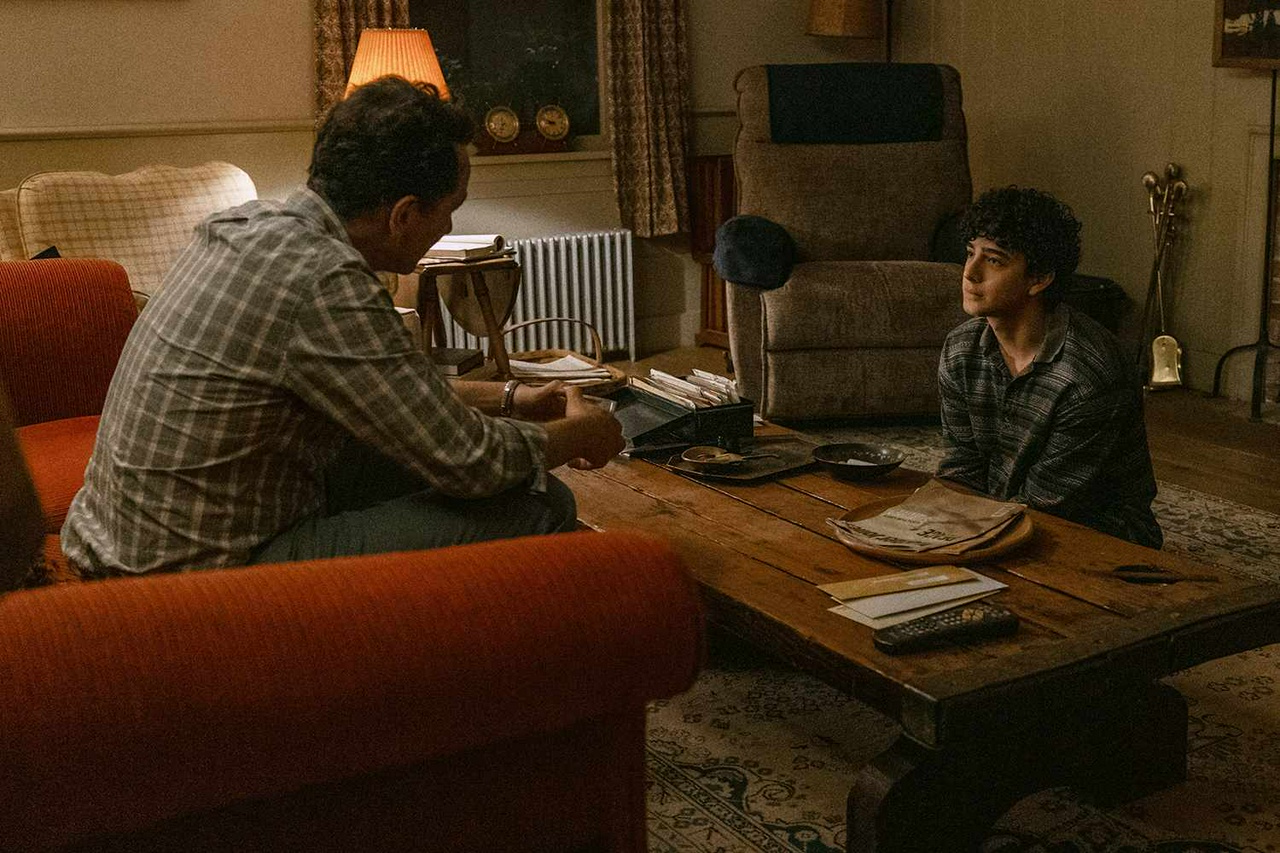
“I really enjoy getting to see Tom [briefly] happy and communicating with his son and planning their futures,” I messaged Caro, “because this does a great job of raising the stakes, because we want this future for Evan obviously.” Yep, we love Evan. (An overprotective parent in a very, very boring setting? It me, I am Evan—internally, at least. Maybe not so much with the sass.)
The episode ends with a massive twist. Which is not much of a twist at all—or if it is, the ‘twist’ begins the moment Wyck discovers the shattered glass display case at the Historical Society, and the ‘twist’ lasts all episode long, etc. Maybe I have a different definition of “twist” than others have, idk.
Episode 108 culminates in Patricia hurrying to Sheriff Bechir’s bedside, while Wyck visits Mayor Tom at home, shattering Tom’s hopes and dreams13 for Evan. Bechir and Tom are effectively facing the same seemingly-insurmountable horror.
Anticipatory dread. It seems the likely bedfellow of “anticipatory grief,” which is a thing I have struggled with for most of my life, and which is considered the primary predictor for prolonged grief disorder—which I think we can all agree is the thing Mayor Loftis has. (PGD was added to the DSM-5 in 2022; previously it was called, colloquially, “complicated grief.”)
Anticipatory dread seems like it could turn into a sort of self-fulfilling prophecy—since it’s the preemptive decision to live in an as-yet-unrealized future, rather than the actual, present moment. I’m not being woo-woo here; I’m still talking about dark patterns. I kind of feel the same way about anticipatory hope, too.
I raved to Caro about the podcast episode I’d just heard. It was a great “digest” of the best observations and theories popping up on social media. “I really enjoy that it FEELS like the hosts are playing a point-and-click adventure game,” I told Caro, “except they don’t actually have a keyboard and mouse, so they can only talk about it.” I added that the co-host Rob was clearly literate in video games, having brought up Life Is Strange, which is considered a “choices matter” piece of interactive fiction.
I also loved when co-host Joanna zagged into a brief discussion of Greek myth: “I was like ‘wow hey this is out in left field for me and I don’t think the writers thought of that, but this is very cool and I like how your mind works.’ The lead-up to that part, though, I REALLY enjoyed—the ‘unstoppable force that cannot be reasoned with, or shot.’ Michael Myers, the Terminator, and yes, always Yul Brynner in Westworld—[Joanna] named all of them.”
Separate from the podcast, though, I’ve been referring to this as episode 108, since creator/showrunner Kate Dippold has been using that numbering in conversation with interviewers. Should Widow’s Bay ever be picked up for a second season—if Apple TV+ would get with it already!!—s2e1 will be numbered “201.” I like this numbering convention a lot, because it implies that we’ve graduated to another year of classes. (The journey of life, they say, is like a spiral staircase.)
“Every day Apple wastes dragging its feet to renew,” I fumed to my friend Rachel, “is a lost day that could’ve been spent already in production for season 2! And! What if Matthew Rhys gets cast in something else in the meantime? Or Kate O’Flynn? If I were casting something, I’d be banging down their doors right now!” I haven’t seen Hokum yet, and I haven’t seen season 2 of Severance yet, but I feel like I can see where the scheduling breakdowns might be occurring. Let’s go! Matthew Rhys is at the top of his game! Don’t be stupid, Apple! Invest!↩
“The cloud” is another way of thinking of an egregore, which is a metaphysical concept, but also, not really!
Here’s my hangup, though. Multiple viewers have pointed out, in fan forums, that the map of Widow’s Bay does look like a hand, reaching sideways. So I suggested, to Caro, a “Hand of Fear” with its potential “Five Fingies of Horror,” and here I even alluded to the parable of the elephant, with various villagers grabbing onto different “fingers” of frightening experiences, unable to differentiate the parts from the whole.
Of course, I’m not sure this imagery totally works with my earlier “Dropbox of Horrors” suggestion, and Caro really thinks my cloud data storage analogy makes more sense.
Nevertheless, I wondered to Caro if this were a Lost situation, where confronting the gauntlet of the Five Fingies of Horror—and surviving them and integrating their lessons—means you’re ‘done’ and you can finally pass through the threshold.
Evan’s mom’s letters—specifically, the scorpion-in-the-brain letter—had me thinking that islanders’ subconsciouses go ‘top-side’ when they pass through the threshold. Evan’s mom’s letter about the “secret mother” cemented that theory. I think Caro is honestly p sick of me talking about Jung, and it’s doubtful that the show will ever explicitly state what’s going on with the islanders’ addled brains, anyway. Still, though. During an earlier episode I was talking to Caro about going through the looking-glass, particularly with respect to Lucy Clifford’s “The New Mother,” the short story that strongly inspired the concept of the “Other Mother” in Neil Gaiman’s Coraline.
I also talked to Caro about the final season of Stranger Things and its uncanny resemblance to Clive Barker’s Thief of Always—noting that this resemblance might’ve even been accidental, as the Duffers were caught using ChatGPT, loooool. However, I wouldn’t be shocked if all these clever ideas about mirror worlds, soul fragmentation, and all the different ways to eat a soul, were repurposed for Widow’s Bay down the road.↩
In one of the first dreams or nightmares I can remember, it was like the end of Ghostbusters, on a burning rooftop, when the boys crack open the singed carcass of the terror dog and Peter Venkman embraces an un-possessed, restored Dana Barrett—except in my dream, the demon dog gave way to my biological mother, who emerged reborn, loving and patient and nurturing and kind and calm. I was, like, four.
If, as Evan’s mother writes to him, “every child has a mother and a secret mother,” it could be said that I was still waiting for my secret mother, I guess.↩
The show is Jungian, in that a ‘dark pattern’ is a daemon: a background process that runs everything else. I learned that, in programming, as in psychology, you use a ‘hook’ to pull a piece of code out of the deep in order to work with it. This suggests to me that Tom and Wyck might eventually have to go fishing. Ah! It’s so Lovecraftian, and not in the bad way!↩
“Or ‘this is how we’ve always done it,’” my best friend’s dad said.
I blinked, startled. “Yeah, that’s an incredibly tough one to crack,” I said to him. “You can couch a lot of abuse in claims of ‘culture’ or ‘tradition’,” and I nodded, “like in a family, or a big corporation.” Like, when abuse is the legacy you hand down, and it’s enshrined as tradition or “company culture,” it becomes unassailable, impervious to intervention.
Then I told my best friend’s dad about my conversation with the retired Swiss potato scientist in the airport. I’d already made the mental connection—although I didn’t bring it up aloud—that, astonishingly, the ex-scientist’s job had been exactly like my husband’s job. It’s just that my husband had been helping designers pass certification for Meta VR’s marketplace; the potato scientist had been helping farmers prepare for the agricultural marketplace. (“They obviously have more rigorous regulations about what you’re allowed to feed people in Switzerland,” I said. “Yeah, countries where they care about people,” my best friend’s dad agreed, flooring me.)
Anyway. Among other things, to pass cert, these VR titles have to be “performant.” If the software doesn’t make full use of the headset’s system and resources, if the game chugs and groans and the headset starts running hot, y’know, the platform itself looks bad.
And the ex-scientist, too, knew which potato varietals were most performant in what soil, and how to plan and rotate crops year over year. So he’d meet with farming families—this is effectively DevRel, the farmers are software developers in this analogy—and he’d talk them through their options, showing them the data.
“God!” I exclaimed, planting my face into my hands. The ex-scientist was surprised by how overwhelmed I suddenly was. I sighed and finally said something about how hard it must’ve been, to try to convince, not these young, modern sons lined up to take over the family farm, but their fathers. You’re trying to convince the fathers of your expertise, to persuade them to completely reconsider how they’ve done things for generations. Obviously a young son will be open to listening, but how do you communicate with their fathers. God!
I didn’t mention VR headsets to the scientist even once. Anyway, my best friend’s dad was amazed by this story, because he’s always been a “black sheep,” trying to encourage healthy change in various… environments, systems, which always goes super well, har har.↩
If the cloud hovering over Widow’s Bay (“There’s something in the fog!!”) is an egregore, then the actual manifestations on the ground are archetypes: story templates. Humans are storytellers.
Perhaps, in order to become visible, something has to be a recognizable story first—something people already know. People get bent out of shape, have trouble trusting what you’re telling them, when the story doesn’t have an obvious, recognizable template they already know. Patricia’s anomalous story of survival is what made her account so unfamiliar and, therefore, unbelievable.
The hardest thing in the world is telling a new story, rather than the same old predictable shit-story. In other words, the way to break people out of rote programming is by replacing an old crappy story with a better one. We already know this about individual trauma recovery; it works for groups of people, too.
Maybe there are no new stories to be told under the sun. That’s almost certainly true. But so many stories are lost, whitewashed over. Even old wives’ tales and fables get rewritten over the years, canonized, so that they carry different lessons or warnings or truths than they did when originally shared. Everything gets rewritten, overwritten. Hmm. Interesting. Who gets to tell a story? And why? And why take over someone else’s story, rewrite someone else’s autobiography? Yeah, I wonder how cadres and councils of old white guys would ever benefit from such a thing.↩
The Dirty John podcast opens with Debra Newell’s daughter Terra explaining a peculiar, particular sense of relief.
All her life, Terra says, she wasn’t sure why she was obsessed with zombie-apocalypse survival horror. She felt like she was getting prepared for something, but she never knew what. When John Meehan—her mom’s psycho ex-boyfriend—attacked her in a parking lot, Terra fought back. Meehan succumbed to his injuries four days later.
And that was it. Terra suddenly felt healthy and normal. She’d been experiencing anticipatory dread all her life, and then the shoe dropped, and then it was like, “Ah! Glad to finally get that out of the way!” Her hypervigilance was gone. Her nervous system finally relaxed. I think she might’ve even said she entirely lost interest in horror movies after that.
It’s interesting because it isn’t exactly trauma that finally got resolved—where “trauma” would provide a proper cover story for Terra’s nervous system, constantly braced for impact—but it is a resolution of a narrative loop.↩
“Your Baggage” was initially conceived as another flashback episode, following Patricia as a Y2K-era teenager the night she survived. It makes a lot more sense as written and aired, I think.
“She has a real victim complex,” Dippold says—explaining the importance of Patricia’s victory over the Boogeyman—“but there is nowhere for her to go for help in Episode 8, so she finally has to do it herself.”↩
Patricia does not put her foot wrong, ever.
With that said, I had but one note for Patricia, and this is a pro-tip from a brochure that came with a Spy-Tech toy in the 1990s: in order to avoid making any creaking sounds as you creep up and down the stairs, you should place your feet on the outsides of the steps, rather than putting your weight directly in the middle. This is potentially lifesaving advice, so I just thought I’d share it with Caro. Obviously, walking all weird down the stairs would not look great on TV. It doesn’t film well.↩
I think at some point I got tricked into believing that ‘likability’ was indistinguishable from nervous system regulation (not that I had this terminology growing up), and that to ‘self-regulate’ simply meant self-suppression: endlessly tolerant of willfully aggressive acts. Look how much I can tolerate.
Well, “be a bitch, or get an autoimmune disease,” as they say. This doesn’t mean you should pull a weapon on every person who annoys you, but I certainly understand the impulse, and maybe more of us should carry tasers for those moments that words alone fail to protect us.
Instead of thinking of the words I’d like to say to people, and then saying the total opposite, I’m trying to be very thoughtful: saying what I’d like to say, after all, but in the tenderest and most loving way I can. (Then there’s the DBT “Dime Game,” which relies on simple math to figure out just how hard you can tell someone to fuck off.)
It’s starting to feel like my nervous system’s capacity is fine, and that my high threshold for tolerating bullshit has been pointlessly chipping away at it. By rejecting bullshit as soon as I see it curving toward me over the horizon, my nervous system can focus on what really matters: screaming children armed with musical instruments, bad drivers, and huskies.↩
In other words, the curse might be revealed by the plot to be some sort of Jinn particle: that is, a chicken-and-egg conundrum with no temporal point of origin, no causation, a “time paradox”—kind of like God in the Creation story.
I do think a lot about love potentially being a type of Jinn particle, but maybe I’m describing kind of a less-dramatic Astronaut’s Wife thing in real life I guess. So if there’s a Jinn particle in Widow’s Bay, it might be between Evan and his parents, or between Tom and Evan’s mother, or who knows.↩
I no longer believe in an afterlife—not in the way an atheist doesn’t believe in an ever-after, but in a timeghost way. You’re your own time gremlin, setting up dominos for yourself like a little trickster, either perfecting the outcome or I guess just looping endlessly. I don’t know; something about The Legend of Zelda and Link.
Anyway, despite not having kids of my own—concerns about epigenetics—I started repeating “heal the tree” in trauma therapy, a mantra, oddly certain that I could affect change in my family from here in the present.
This is a weird idea to suddenly glom onto when you’re 40 years old; I guess that’s just the shape my particular midlife crisis has taken. It was probably all that Covid I had.↩
I messaged Caro regarding the final line of episode 108, Wyck’s ominous It’s not over.
“Matthew Rhys’s reaction required such a mix of conventionally neurotic Tom,” I messaged, “but also horror Tom and grief-riddled Tom and it would be hard to get the right face but he did.”
“He’s honestly so perfect for this role,” Caro agreed.↩