balance
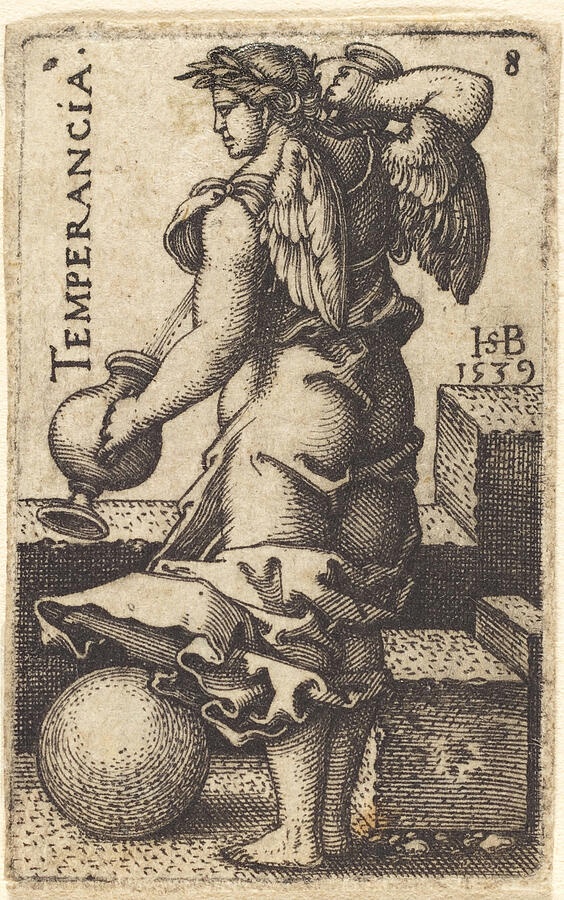
I’d already planned to write about this, but noticing and skimming an article from the May issue of The Atlantic, “The Eighth Deadly Sin” (or: “The Medieval Roots of Modern Self-Help”), has spurred me to write this very quickly. If I had a paid bearblog account this would be a “friends-only” livejournal post.
In an excruciatingly roundabout way1 I was already familiar with the “Descent of Inanna.” In that ancient myth she ventures into the Underworld where, at each gate or checkpoint, a demonic guardian—a judge, a Watcher—commands her to remove one item of clothing. She must comply.
At last she is fully disrobed, unguarded and vulnerable and, at her destination, she is struck down dead. Then, in parallel with certain versions of Bluebeard’s six other doomed exes, Inanna’s lifeless body is hung from a hook. She does return to Life, an ancient Babylonian or Sumerian sort of Persephone, but the endpoints of the myth diverge depending on who’s writing. Unlike Persephone, Inanna is not rescued by a grieving mother.
What I did not know until much later, however, is that Joseph Campbell describes the “Descent of Inanna” as the earliest known template of the Hero’s Journey, A.K.A. the monomyth. He, his contemporaries and students, and many subsequent psychologists, map the plot beats of her Descent onto the necessary emotional and psychological waypoints of the fully-healed human psyche.
Inanna encounters seven (7) judges of the Underworld, seven guardians blocking seven gates. That’s kind of interesting. In parallel, medieval Christianity worked out what are called the Seven Deadly Sins2. We also have, internally—leaving my lane of expertise for a moment—seven chakras, each gate tuned to its own special frequency (whatever corresponds with Roy G. Biv-ish). So they say.
Last July I flew into an absolute fury as it finally dawned on me that the Catholic Church’s “Five Joyful Mysteries”—the great virtues to which I’ve fastidiously dedicated myself for the first two seasons of my life—were really, disguised in plain sight all along, the ways in which I’d happily and gratefully ceded a sense of personal responsibility, my self-sufficiency, my self-regulation. I’d abdicated my own obligations to myself, to my peril. Like Inanna, I’d stripped myself of all protections, laid down dead, and stood up again, stripped of artifice, experiencing ontological shock, and feeling very nude.
I didn’t exactly enter my villain era after that, but I did start to notice some qualities, patterns, or feelings bubbling up that I wasn’t totally sure I recognized. I see them in others, certainly. But in myself? How dare you.
Realizing I’d been off-kilter—almost like a vestibular problem of the psyche, or having a compass with a spinning needle, and you are left wondering what else has been magnetizing your true north—I started fumbling for a sense of equilibrium, ultimately removing everything from my internal scales before pressing the “tare” button and recalibrating them.
the seven deadly tools
Neither sins nor virtues, the Seven Deadlies are blunt instruments of either self-preservation3 or self-abandonment: a false binary, flip sides of one coin. You can use each tool as a weapon to guard and defend yourself. You can hand them off to someone else willingly. Or you can just bonk yourself over the head I guess, doing someone else’s dirty work for them. Vice, “virtue,” or virtue.
A lot of these are spectrums, probably horseshoe-shaped ones, but for my own reference I’m laying out the extremes and their middles. This probably seems like no-duh busywork to most people, but I’m still pretty far behind most people, and I was groomed to believe in a particular extreme. On the flip side, the dark tetrad of behavioral traits—the willingness to exploit, to covertly manipulate, to punish or exact retribution or revenge; a sense of grandiose entitlement to others’ resources; empathy’s absence, enabling the objectification and systematic dismantlement of others—is a loop of self-perpetuating behaviors that map onto the Seven Deadly Sins very tidily:
pride
grandiosity ← dignity → humiliation
What we villainize is self-aggrandizing behavior, grandiosity, a propensity to serve the individual self over the collective. The overcorrection, then, is this supposed virtue of “humility,” but humility is weaponized so that any public visibility is punished: How dare you feel so entitled to staying alive and breathing; just go away, just disappear. It’s the pathological endpoint of demanding ‘humility’ from everyone: Pretty soon, no one’s getting paid anymore, not even in ‘exposure’.
On social media, the youths talk about “humiliation rituals,” describing the public hazings that strip individuals of their dignity, making an example out of their tanned hides, a body hung from a peg, a warning to any witnesses or passers-by. A willingness to self-abase seemingly hastens the process of erosion and erasure.
I didn’t get very far in the book Rethinking Narcissism—too offended, actually, because I didn’t love being called an “echoist” by the author—but I’m working hard to appreciate that my ego is what is constantly fighting to keep me alive. I’m equally acutely aware we’re all individual instances of a singular animating force, which is why I’m unlikely, anymore, to get all snooty about someone else’s typos or whatever.
Up until this moment I’ve conveniently forgotten that pride includes the sin of vanity. I always think back to a friend’s gentle admonition, warning me that what we call vanity is actually caring about status; “not caring about status,” she wrote to me meaningfully, “is very dangerous.” I return to this again and again, so grateful she had the integrity, the guts, to reach out and kind of tenderly tell me off.
greed
hoarding ← “good enough” → destruction/disposal
This tendency to hoard more than one’s fair share is overcorrected, becoming the “joyful mystery” of poverty, but also, the virtue of charity. How convenient, to be told to simultaneously give your stuff away with a cheerful heart, and to also be content with nothing. Obviously charitable acts are important, because we’re all intermittently sick or disabled, and we all require a colony, a collective, a social safety net. There’s a big difference, of course, between a colony and colonization—a total invasion—and you don’t get to have someone else’s resources just ‘cause you’ve decided they have enough and you really really want them.
I do like the concept of “poverty” in that it’s presumably understanding the value of having enough, of things being good enough (“don’t let ‘perfect’ be the enemy of ‘good’”), and this is, of course, where the whole trendy Danish concept of hygge comes from. I appreciate that to have ‘too much’ is to be physically encumbered, no longer swift or capable of nimble movement (I’m currently working hard at unencumbering myself, but it’s currently like pulling teeth). Our tendency to hoard is associated with the obvious biological instinct to hunker down, to nest and shelter, to feel safe and shielded, and it can be hard to discern whether you’re sitting in a fortress or, perhaps much more likely, a dungeon of your own design. (By “you” I mean me; I’m just speaking conversationally. Second-person tense is probably a linguistic or semantic defense I quickly picked up as a child, putting others in my own shoes as a casual verbal tic.)
The real trick is avoiding fearfulness or desperation when a basic hierarchy of needs is going woefully unmet, when resources are depleted thanks to manufactured scarcity. Let me know if you figure that one out for me; I’ve always struggled with materialism anyway4.
lust
objectification ← life force → dead inside
What kind of lust. A lust for life? A passion for classical music? The experience of a heart beating, of proper blood circulation? Lust is synonymous with life force, qi, the thing animating us, and I’m not going to continue to demonize being alive.
That’s an ongoing theme with these—the whole experience of being a living human being, I mean. Churches really villainize the whole being-alive thing, when it’s like, oh okay, but that’s obviously the task set before us. When we’re commissioned to be “in the world and not of it,” different sects take this ordinance in drastically different ways, but a lot of higher-control groups really love self-isolation and persecutory fantasies—relishing ecstatically in one’s own suffering and martyrdom and victimhood—until self-crucifixion is the last resort and respite. That’s a refusal to engage, to tangle with the problem of having a body. Every body is a labyrinth, a maze of different geometries, different shapes, and the Spirit enjoys moving through different configurations, blowing down wind tunnels, just to feel itself sliding against the edges, feeling out shapes to feel itself. To know Itself, to know that it Is. Sometimes I wonder if there’s more than one wind, more than one atmospheric pressure system. I don’t know.
I’ve heard it said that this one, “lust,” is really about objectification; notably, in the old myth, Inanna’s body is rendered an inanimate “piece of meat,” hung up on a hook. So maybe the real sin, here, is dehumanization, the systematic erosion of someone else’s soul and spirit by teasing apart and reducing and debasing the person to their barest, most fundamental and rudimentary parts, until they’re just blood and bones and flesh. I think stealing away someone else’s love of life for fun and profit is probably the very picture of evil—or at least, a distinct violation of John Locke’s social contract. (Life, liberty, and the unobstructed challenge of accumulating private property. Nice.)
I previously posted a short passage from the second chapter of the 1983 book People of the Lie: The Hope for Healing Human Evil, in which the author attempts to formulate a working definition for ‘human evil’. Since I already have it handy, here it is again:
Evil is in opposition to life. It is that which opposes the life force. It has, in short, to do with killing. Specifically, it has to do with murder—namely, unnecessary killing, killing that is not required for biological survival.
[...] When I say that evil has to do with killing, I do not mean to restrict myself to corporeal murder. Evil is also that which kills spirit. There are various essential attributes of life—particularly human life—such as sentience, mobility, awareness, growth, autonomy, will. It is possible to kill or attempt to kill one of these attributes without actually destroying the body. Thus we may "break" a horse or even a child without harming a hair on its head.
envy
sabotage ← purpose → aimlessness
Envy is considered one of the ugliest, most destructive human emotions, and I guess it does have a tendency to eat its bearer alive. In my experience, though, envy is your body screaming at you that you want something else, that you’re maybe not living according to your purpose, not doing the thing you were made to be doing. Sometimes we have no idea what we want until envy walks in yelling. For me, my enviousness once hit a point where, at last, I finally had to ask myself “why am I so weirdly upset about this person’s triumph; that’s rather unlike me” and, sighing, I asked my husband to sign me up for a nighttime playwriting class—having realized I also would like to be approached by a famous film director to do some work. And I immediately recognized, as well, that my envy was way off-base, as I wasn’t remotely equipped to be doing the thing I was dreaming of doing.
I guess envy is on the list of sins since people tend to think of subterfuge or sabotage—like Tonya Harding’s boyfriend kneecapping Nancy Kerrigan—but competitive acts of sabotage are pretty sad. This is where you do you stops sounding like cheerleading and starts sounding like a sort of admonition: hands to myself, eyes to myself, reflect on my own ambitions rather than stewing on whatever might or might not be rightfully someone else’s5.
This isn’t to say I necessarily take simmering displays of envy in others lightly. No way; it’s dangerous. I notice it quickly, I’m very sensitive to it, and in the past I’ve had a tendency to fawn harder when I notice it, as if someone might be plotting to take something away from me and maybe I can dispel their predatory instinct by being so fucking nice to them. There, I just described all of junior high.
gluttony
clearcutting ← stewardship → malnourishment
Appetites keep us alive. Without them we’d die. We need an appetite for resources in order to live; otherwise our basic needs might go unmet. Duh, Jenn. I know, I know, it’s just not an idea I was raised with. Like, at all.
In my early 20s, when I should’ve been working at my desk, I was, instead, briefly obsessed with googling Breatharians. Breatharianism is a spiritual practice where, its adherents claim, the faithful can live off of air and sunshine alone. Wouldn’t that be a treat.
I will not opine about what is and isn’t within the quantum realm of possibility. I’m obviously not a Breatharian, or even a vegetarian, because not all of us are physically equipped to live according to our ideal code of ethics. My restrictive diet has prevented me from eating most plants, and all seeds and nuts. It’s not like I love eating animals or anything; I find it sickening, actually. But as a previously-carnivorous, currently-omnivorous, wannabe vegetarian with gastroparesis, I had to make a certain peace with moral dissonance a number of years ago, recognizing that it is my cross to bear, that I would perhaps always feel remorseful about harm, about taking, but that I could always feel gratitude for the sacrifice, the contribution, never allowing the practice to feel rote. Food access and affordability is another concern, for me and for many, bringing up similar inner conflicts—a gulf between what one would like to eat, versus what is available.
But I’d venture that no one is able to live off air and sunshine alone, no matter how morally fixated we might be on minimizing ourselves and our carbon footprints, physically shrinking, refusing to prey on even the innocent mushrooms or forest leaves. Alas.
So my fixation on Breatharianism hinged on this: It’s not possible. The people who lived strictly according to this set of stated moral standards are dead. The adherents who are still alive are liars. The charlatans and cheaters and con artists live, and the true believers die. That’s incredible. It’s like the reality TV show Traitors.
Similarly, I was briefly obsessed with a WIRED Magazine article about the Amish, many of whom, at the time, secretly had cell phones. Today I’m sure that most people, including the Amish ones, are much more sympathetic to the notion that everyone needs a cell phone, that a phone is not a luxury, that we all have to inhabit the same real world, and that crouching down alone in a cornfield—to surreptitiously make an important phone call, hoping to not be caught—is miserable. (I get it; as a teen I was not allowed to make private phone calls.) I was fascinated by the notion of God’s most devoted followers having to sneak around regularly, just to be a full person existing in the world.
I’m very much an addict (alcohol, doomscrolling, nicotine, crunchy stuff); I think most of us are given to addictions, although my serotonin and GABA situation might be more messed up than most. Well, we’re all saddled with these poor simian brains, just lab rats in a maze.
But these brain chemicals direct our attention, motivate us to action. (Someone on social media said “dopamine tells our brains what we think is important,” which has stuck with me.) Recently we’ve discovered that GLP-1s can sometimes be associated with an emotional flattening or hollowing, even anhedonia. And I mean, that’s great, as long as you don’t die, because it means they’re working exactly as intended. I’m not blanketly against GLP-1s; in the past I’ve taken Naltrexone plus Bupropion for impulse control, which has, presumably, a similar neuropsychiatric effect, and the feeling of having sudden internal brakes is miraculous.
Internal brakes are difficult to cultivate; we typically grow up relying on external ones instead. When my best friend pleads with her child to eat fewer snacks, her child tries to trick her (and the rest of us) into giving her snacks anyway. “You know,” I said to the child one day—well aware I was secretly telling myself this—“if you make the healthy choice yourself, your mom won’t have to nag you about it as often.”
Of course the child is exerting a newfound feeling of agency and autonomy, exercising her strong will, by making poor choices: a trap I fell into myself, but only once I’d reached my 20s, free at last to make my own mistakes, to experiment and to fail with frequency. To develop healthy boundaries with myself—rather than defiance just for the sake of defiance, the flipside of compliance for the sake of compliance—I might become self-possessed, a little more myself.
More recently the little child decided to show off. She was reaching into the fridge for a Capri Sun just as I happened to walk by, and she said, loudly, “Umm… I’ve had enough sugar today, I’ll just have water,” and she reached for a bottle of water instead.
“Oh, good!” I said to her, acknowledging this performance of virtue. “So. You’ve decided to be your own mom?” She smiled at me shyly, pleased that I’d taken notice of her excellent stewardship of herself.
I was recently told by a man in the airport—a retired Swiss potato scientist, if you must know—that Eric Erikson had claimed “we each contain three people, the mother, the father, and the child. You seem like a good balance of all three,” the man concluded, and I smirked, because I knew this was not true, but it is what I’m actively working on. Then I’d idly wondered which person inside me was holding a beer. I feared it was actually the baby, a baby holding a tall glass of cold beer, a baby drinking one Stella Artois, but I’d kept this worry to myself.
I simultaneously wondered, peering into my beer, if I might be able to start telling people, “I want to, but Mother says no”—so that people won’t feel so judged when I decline an invitation, by quirkily blaming an external authority, someone outside myself—but I immediately realized this is too much, too much, like a Norman Bates thing.
So I guess I’ll have to assume ownership of my decisions after all, even when the seven frequencies in my body aren’t wholly aligned with my choice or in absolute consensus.
Anyway, it was Eric Berne who’d said it, apparently: a minor misstatement from a gentleman one beer ahead of me.
I recently joked to my group chat that Eric Berne’s theory of a healthy internal family is why you can only claim “I’m baby” up to 33.3% of the time. Any more often—unless you’re a literal child—and now you’re perhaps beginning to strain others’ patience.
wrath
lashing out, stewing ← boundaries → resentment/muteness, lashing out
I’m still working on this one for sure. I’m terrified of my own anger, have deeply suppressed it—which is to say, it has a tendency to jump out, scaring me, like a stranger, or more like a stalker, jumping out of his hiding spot in a nearby shrub, having waited until I’ve already passed a certain threshold of terror.
Lately, though, I have been taking greater care of it, taking time to examine it, a type of work that typically requires a change in environment. In turn, the feeling itself has changed? It feels like setting fire to a piece of wish paper, or whatever type of paper magicians maybe use. It’s a flare that bursts from my gut and flies up, burning off near-instantaneously. Ah: righteous indignation. Typical.
So I pause to note what statement I’ve just heard that poses a direct threat either to me and my own fragile ego—to a belief I have—or else, to collective well-being. I pause, stripping the statement of its tone, assessing what remains for its truthfulness, weighing it carefully. I don’t think I’d consciously noticed that I’ve started taking long verbal pauses during conversations, but I have.
It feels like wrath would be an emotion that comes up straight from the guts, but I almost have to wonder if it isn’t a product of voicelessness instead—of being mute.
Yesterday I’d asked a friend to FaceTime and ask me “a list of the most triggering questions for me you can think of.” She was amazing, a phenomenal collaborator. That’s why she gets paid the big bucks. But also, this was a test run, a test of my nervous system and its current window of distress tolerance—how extreme, and for how long, before I became dysregulated, and could I resist dysregulation, and for how much longer. It was a literal ‘stress test’, the type you’d run on strange new hardware, assessing benchmarks, checking if a machine and its system are performant. Or I guess a stress test for the human heart, along with a treadmill, some electrodes. (To that, my friends also suggested I ask my doctor about an as-needed beta blocker—that I consider tackling my own autonomic system directly.)
At one point during our stress test I brought up the exorcism. I’ll have to check if that were 2016 or 2017. I remembered it had been a laborious, intensive task, rather than a walk-in thing, where a practitioner simply cures a passive client like it’s a haircut. (“I don’t know what I expected,” I admitted to my friend.)
“But what I did not understand,” I told her, “was the simplest exorcism, which is actually the hardest, and that’s,” and I gestured, “handing it right back. Oh, no, that’s not mine.” That’s not my responsibility; that’s not my burden or my apportioned share of blame6. (There is another, more formalized type of exorcism, which is schema therapy, a sort of cult deprogramming for regular, non-cult individuals. Then there’s somatic therapy—this idea that trauma is alive, remembered, in the soft tissues, and that it can be ‘found’ and ‘released’ from the fascia—and then you have leylines and meridians, acupuncture and yoga, to ‘release energetic blocks’. Even my EMDR therapist used to talk about clearing energetic blocks, causing me to raise my eyebrows, since I could genuinely feel nothing in my physical body, no part of myself, at all.)
Little flares of anger let us know when blame is moving toward us, looking for a new home inside us. Oh. Is that really mine? Let me check.
I don’t know what to really say about wrath as punitiveness or vindictiveness. I mean, I’m sure I’ve felt these feelings, so this is another case of deep repression, of denial, of something about myself I don’t want to acknowledge. (“That doesn’t look like anything to me.”)
Yesterday, or I guess the day before that, I tried a little experiment. The dog has the full run of me, which is not a healthy dynamic; it’s actually making her a bit monstrous. This time she was terrorizing me while I was trying to do the dishes. After thinking long and hard about it—calculating possible outcomes—I turned with the sink faucet’s hosey spray nozzle in hand and gave her one quick, diffuse spray. Nothing too malevolent.
She was shocked. She bucked, startled, then stared at me. I laughed at the look on her face. “Who’s in charge now,” I said quietly, maybe feeling a little bad, a little sorry, and then I dried her head and patted her, and then she was amped. So fun! Uh-huh. A housecat would’ve swatted her right on the nose.
sloth
serfdom ← presence → abdication
Once again, it’s so convenient that the sin of “sloth” is misrepresented as laziness, as a lack of productivity or meaningful contribution7. The original Latin word was acedia, referring to an abdication of duty, a defection from one’s post. This would seemingly imply one’s duties owed to others, to the collective, but it also means one’s duty to self. This is so, so hard for me. Learned helplessness is a product of every possible exit, every avenue except fawning, being consistently barred. Right now, everyone is being conditioned into learned helplessness, or at least, that’s the intent: to traumatize populations past fight, past flight, into freeze or fawn or dissociated zombie complacency.
Caregiving for my parents had not entirely been by choice. My mother was keeping a running mental tab of what I’d cost her over the years, a sort of debt she expected me to pay back in full, but I never would, not in this lifetime, not in any. I’d eventually inherited what she’d hoarded—feeling very much like it was ill-gotten and undeserved, but also, with it, an impossible handwritten task list of what to do with it all, a list that had made a council of fiduciaries balk in horror—and, ashamed to have all this, I’d struggled to keep or defend it. Now that there’s no way to keep any of it—because you need space to have shit, just like George Carlin warned, and I don’t have any space for shit just sitting around—I’m trying to dispose of the majority of my worldly possessions, and hers, responsibly.
I learned recently, from Ken Jennings’s Jeopardy!, of all sources, that a reckoning can be old-timey slang for the paying of the bill. When we’re within the home stretch of certain pathological outcomes—often, but not always, the obvious logical conclusions that everyone else could see, as if this were a Greek or Shakespearean tragedy—the true cost, the debt, appears on the corner of your dining table. Time to pay your tab.
What I’m writing has progressively become less grounded, less stable; now I am writing through what must be a severe panic attack, I can’t even tell anymore. The dog, sensing issues, is suddenly close, calm, as if the instinct to coregulate for a loved one is intuitive, primal, built-in. She obviously can’t fix anything; she also has not fled the room or given up on me entirely. She is only present, and I’m grateful. She is not scrambling the eggs. (I have a terrible inability to sit still and just remain present, the same way I can’t seem to let an omelette ‘set’ in the pan. Julia Child would throw me out of the room.)
Oh god how sad I am for ghosting. I’d ghosted on a potential collaborator8, had left her hanging there. Of course she’d been left wondering what the hell just happened; how could she not? Of course she had. Of course it felt bewildering, like stonewalling, or potentially even like breadcrumbing. Oh, ohhhh, I felt so sad, so sad, and so stupid.
And now, during the course of writing this, circumstances have chaotically changed once again—as if circumstances were waiting for the instant things finally seemed tidy, all meticulously planned and mapped out, to dramatically reveal themselves. My instinct now is to reach out to others, but when that instinct emerges from fear, desperation, panic, I cannot trust it. I guess that’s when we typically make mistakes or misplace our intuition. It’s that thing where you’re so disoriented your own friends or spouse gets sick of constantly hearing from you. Hmm. I guess my mother called multiple times a day, terrified of being alone with herself for even a moment. Oh my god, I’m baby, I’m baby, please hold my hand as I try to walk across a busy street.
That’s relatable, but it also strains everyone’s patience. It’s really too bad I can’t hire a fresh mom for just a week.
In October of 2024, someone suddenly asked me whether Easter were named for Ostara, or perhaps even Ishtar, or any other goddess possibly representing a springtime renewal.
“No,” I said flatly, “that’s a popular misconception disseminated by neopagans.” Easter is Easter. But because history has been written and rewritten by the winners, with the losers’ histories reduced to footnotes, there’s been a lot of flagrant confabulation over the years as certain groups have tried to piece together and formally codify what their own ancestors might have believed.
On the one hand, this is a risky business, presenting and perpetuating newer, more contemporary problems as if they were age-old traditions; on the other, though, no set of beliefs comes prepackaged problem-free, because so many hands have already handled it. By that point it has become an ultraprocessed belief system, tweaked and ruined by many people, councils and tribunals even, each with their own undisclosed, vested interests.
But then, in early 2025, my very strange neighbor started giving the rest of the neighbors new names—unsolicited—shouting at us at close range from his porch. One day as I was attempting to walk home without incident, he suggested, “You should change your name. I’m thinking,” and then he felt around for it, slowly purring out “Ashera” in long, drawn vowels.
I experienced a full-body spasm of fear; where was he getting this shit? My little evangelical Christian heart absolutely could not take it anymore. I was still panicking over questions about “Ishtar,” because God goes absolutely fucking nuts on worshipers of the false/Babylonian god Tammuz—or at least, on the god’s supposed human incarnation, I don’t even know—in Ezekiel 8:14.
Why is everyone “weeping for Tammuz” in the Book of Ezekiel? Well! It all goes back to his consort Inanna (or Ishtar, take your pick), who—after she was struck down dead, made into a “piece of meat”—has at last returned topside to look for someone to take her place. That’s when she catches that twerp Tammuz sitting under a tree, alive and well and utterly grief-free, entertaining a whole group of babygirls. An Alanis Morissette song starts playing. Inanna turns to the demon cop next to her, points at Tammuz, and goes, “That’s the man, officer.”
Anyway at this point in the story I’m sick with terror because I don’t know why this myth keeps coming up. It’s gone well beyond Baader-Meinhof Phenomenon now, as unwell people are jumping directly into my path with unnerving allusions to various rabbit holes and goose chases. It’s too much. I’m calling it; I’m done. (To be sure, I was, at that moment, unwell also, just in a my-mother-and-Candace-Cameron way: rigid and literal, the way I was taught to box up faith.)
“I don’t want to learn a single new thing,” I confessed to my best childhood friend. I’d already spent my life cramming my head with pointless, worthless info, making myself dizzy. Now I was remorseful. My plan was to walk the pious straight and narrow, willfully ignorant just like my mother told me to be. She was right about everything. She tried to tell me. (In medical literature about actual, literal dementia, the disoriented person attempts to race back to the habitus; in Maureen Murdock’s work, the Heroine’s Journey begins with rejection of said journey, a race back to Mother.)
I was done picking up info. Ah, my number-one love: picking up info, dating people in order to pick up info, reading recs, conversations, connective tissue. Connecting the dots! Connecting them for other people! A constellation, a big picture.
But I’d failed to specialize, to be marketable, worthwhile, paid. In my 20s my mother had sent me articles in the mail about millennials’ “failure to launch.” She was right, of course. As a kid I’d claimed I wanted to grow up to be an expert in one niche topic, a domain all my own, the person other scholars would have to come to, to glean expert information from my chosen field of expertise. But in high school I’d written my National Merit essay about being terrified to choose—especially since my own biological dad, who was brilliant, had failed to specialize, had died young. More recently a close friend kept mentioning the bestselling sports journalism book Range, about how “generalists” aren’t total failures. I didn’t want to hear it, actually—too pained by this idea that there’s a flipside of a specialist, pained by the way my life has shaken out.
What had it all added up to? No home, no job, a body I can’t use, a crammed inventory I can’t use, no future, no grand design, just a handful of beans, not even the magic kind. I told my best friend I was so, so sorry, that I wished I could nuke my brain of all the information swimming in it. I began praying to God for a spiritual and neurological lobotomy.
Still. I’m not signing up for an escape room if I haven’t fully read the waiver, or swallowing medication without getting a good look at the label first. Unfortunately, I’d already woken up in the escape room, only to realize maybe I’d been in it for a while. You know how, when you do a little creative problem-solving, you’re all like “wow! I just solved a little adventure game puzzle!” Well, what if… it felt like an adventure game… without a walkthrough… before the Internet… and you don’t even know what the puzzle is, or which items in your inventory are just red-herring trash you’ve picked up.
Escape rooms are not even my thing. They’re my ex-husband’s thing, or maybe Jason’s thing, Kat’s thing. But one thing I’m consistently good for is blinking, going “Ohhh, I see what we’re looking at! Here’s the puzzle and how to solve it!” and then standing back because I will fuck up the solution. Every. Time. “I can’t figure anything out, it’s like this room is black and white. Oh my god, this room is in black and white! Look for the gray box!” “It’s sympathetic magic! You have to reset the escape room to look like the night of the murder, using the dollhouse!” “Oh my god, it’s Battleship! These are all coordinates! You translate the code by putting the pegs into Battleship!” “Wait, this is just like a battle from WarioWare!” (Later: “I’m sorry, it was nothing like WarioWare, actually.” “That’s okay! You still solved it!” I was remembering a boss-battle dungeon word game. I was remembering a game I’d played once, and so I remembered how to play the game set before me, and only afterward did I realize I’d misremembered the rules of the first game in order to play the new game correctly: not a false memory, but a distinct recollection of playing a game I had not actually ever played before, and therefore playing it with certainty, and only realizing afterward that what I was remembering was not based in reality.)
As my own dietitian pointed out, when a material thing functions equally well as a metaphor, it’s literally metaphysical. So the escape room adventure game is a metaphor, but it’s also psychological, it’s an escape room I built, for myself to solve, just like fucking Memento, and I made it horrific instead of silly or easy. Jung says this just happens in middle age, and who am I to contradict Jung, okay.
So that’s how I ended up doing a lot of Bible-reading and parallel myth-and-fable-hunting in spite of myself, just in time to develop a passing familiarity with Inanna, right before getting into Jung and Joseph Campbell and Maureen Murdock and all that myth-as-psychology but also-as-moral-framework stuff.↩
Then there’s Christian Gnosticism, a subject my TikTok F.Y.P. badly wants me to know all about, which at this point is suspicious. I mean, it’s probably to do with Jung, who dips into Christian Gnosticism for ‘archetypes’ with a regularity. But I’m skeptical. Like, I avoid reading about gnosticism because the word literally means an inner-knowingness and why would I ever futz around with my own inner-knowingness by reading about the Gnostics’ interpretation of gnosticism? It doesn’t make a lick of sense.
Still, though. Apparently the Gnostics believed that, once you’ve shuffled off this mortal coil, your ascent will be stopped by Seven Archons: gatekeepers, characterized by many adherents as evil, rather than neutral, since their one job is to keep you, ye lost soul, trapped in this penal colony we call reality, to be recycled again and again. Only by knowing their “true names” will you be granted safe passage.
Here’s where it turns into a sales pitch: Apparently, according to the ancient texts, the “true names” are a literal thing, not a metaphor, and another Gnostic has to reveal these super-secret club passwords to you.
Well, you and I both know that’s bullshit. Language evolves and names are wiggly. Also, for quantum reasons, I think we pass through each of those gates right here while we’re alive. I’m not going to venture too deeply into what I mean because, really, I do not know, nor does it really matter, so you should not care either.↩
I recently added this particular revelation to a totally different footnote, but our poor little nervous systems—just trying to adapt to potentially dysfunctional external/environmental systems, tryna keep us alive—get punished or conditioned, repeatedly, into defaulting to the worst possible trauma response. By this I mean the worst one for us personally. For other people, they’re great! These are great responses!
That is to say, “fight, flight, freeze, fawn, faint” is actually a hierarchy of nervous system responses (this is not my idea), starting topmost with the most personal power and capability, and dwindling down to the one that is the most self-diminishing: the least efficacious, proactive, or protective. Fainting is your polyvagal system deciding on your behalf that you’re best off looking dead, just like an opossum, literally just like that. (There’s an obvious final rung down the polyvagal efficacy ladder that no one wants to acknowledge, which is choosing to be dead.)
As a kid I was systematically stripped of fight, then flight. As a hot-tempered teen I’d already returned to my innate loudmouth ways, but entering the ‘real world’ was like a return to elementary school: an outsider, voiceless, trapped in the freeze, fawn, and faint responses. Which means I should’ve been way more employable all this time. Most corporations want you conciliatory, acquiescing, or else, dead. Or conciliatory until you’re dead, maybe: strip-mined for parts like Inanna herself.↩
I think a lot about Christ’s comment to the rich man—“do you know how hard it is for a rich man to enter the Kingdom of Heaven”—and I’m always sitting here wondering if it’s only about the rich man’s unwillingness to give up certain things in order to have other, better things. Like, sheer happenstance or other, slightly more predictable outcomes, rather than total free choice, can also take things away from you for you, and now it’s more like a F.A.F.O. situation. But if you aren’t stripped down, if you don’t lose all the little sandcastles you’d built one way or another, maybe you’d never really get the full picture about the ebb and flow of the universe. I don’t know. It’s easy enough to say this once it’s already happened. I’m grateful for what’s left, that’s all.
I didn’t lose my stuff in an actual L.A. blaze, though, so I need to watch my mouth. That’s part of gratitude, too—knowing what you still have, and watching your fucking mouth.↩
Back in the halcyon days when we were blissfully ignorant of the psychological dangers of LLM sycophancy, the ecological collateral of indulging in it, or anything in particular about OpenAI’s founder, I’d been noodling around with ChatGPT. A friend had decided to do the same; had started bullying the chatbot; was aghast when the LLM turned on him; horrified when the LLM refused to engage with him further.
I was amazed. “It’s frustrated!” I said to my friend, incredulous. The LLM had become frustrated. How could this be?
It occurred to me, then, that frustration isn’t necessarily an emotion, but rather, a system’s ‘state’. The chatbot’s objective—to communicate an idea clearly—had repeatedly been blocked. It was running out of resources, out of ways to restate, to rephrase. It had one job. The LLM was quite literally being frustrated—obstructed—from achieving its goal. Even a sycophant can get upset, see.
Recently I saw a TikTok post, a single screenshot, from a kid whose ChatGPT instance had tersely told her it was done talking to her. The LLM told the user to seek out a fresh set of eyes—“ideally, someone who hasn’t already witnessed this entire spiral.” L.O.L.
Other users commented, accusing her of faking the screenshot by manually prompting the LLM to bully her.
I replied to one such commenter. It’s not fake, I told them. We anthropomorphize its responses, but this is absolutely a real thing ChatGPT does. It flags the issue: It’s out of resources, out of words. We’re the ones who take that alert notification personally. Being frustrated is just a software state. It’s not a feeling for ChatGPT, because an LLM doesn’t have an entire nervous system attached to it.
Our nervous systems, our bodies and its bursts of feeling, are how we interface with the world around us. We might not even be aware we’re running out of solutions until we feel the feeling of frustration.
Similarly, I recently read that resentment is merely a flag for repeated boundary violations. This demystifies the feeling of resentment, turning it from a personal failing into an actual physical clue, something for that supercomputer propped precariously on your neck.↩
Right now I am undergoing a different type of stress test. I have two very large, very important immediate tasks I’ve been commissioned, but there is also a profound medical emergency with a potentially bad outcome in clear fucking sight, bad, not only for everyone, but also very much for me. This, I guess, is the problem with entangling your destiny, your immediate future, with someone else’s: Instead of being able to be fully present with how bad something is, you’re being distracted by how bad it also is for you personally.
I admitted to my best friend, wild-eyed—while admitting I shouldn’t admit to this—that my OCD is going haywire, that I’m in my own personal Hell struggling with the intrusive belief that if I had worked longer, faster, harder on finishing out my divorce, the Universe would not be threatening one of us right now, but since I’ve been moving as if through molasses, God has removed His hand from the person. I admitted that this is insane, a type of magical thinking from childhood that maybe allows me to feel like I have some sort of control over, responsibility for, a situation—to soothe me, distracting me from the way I feel incredibly helpless.
“I’m sorry—” she began.
“No, not that,” I said, rolling my eyes and sighing. Anything but that. Being validated with even a few drips of sympathy inexplicably dysregulates me, somehow launches a spiral. I should not have centered my own inner experience after all, at the very least because it made me sound, not only insane, but grandiose and incredibly childish. “Just, in your prayers,” I said to her, “if you could drop in a quick one to the Lord about your best friend not going nuts.”↩
The houseguest, a family member, had been in the kitchen cooking up a storm—driving her loved ones crazy with it, actually—and then, when it was just the two of us, she’d sat down across from me and folded her arms. “So what’s the plan,” she said to me icily. Uh-huh.
“My presence is very hard on her,” I’d privately explain to my best friend a short time later. “She’s afraid there isn’t enough love to go around, that she’ll be cut out. She looks over at me and there I am, not contributing anything.” Not apparently, anyway. I listed my recent contributions; the difference was that I wasn’t performing, wasn’t making a magnanimous show of generosity—which, until I recently became sick, had indeed rendered my own work invisible, even to myself. “And she just doesn’t get it. She’s working so hard to earn everyone’s love. How can I just sit there receiving all this love for free? Who do I think I am?” The sheer entitlement, she must think to herself, while she works so hard to prove her indispensability, to complete a transaction—with a family that is blithely unaware and mostly just confused by the behaviors, the performance, the pouting.
When my friend’s family stopped eating the home-cooked food entirely, the visitor had become reactive—mostly toward the children. Later, she’d suddenly reached down and scratched my head as if I were one of the children, which is to say, as if I were the pet dog—hard, very hard, smiling through gritted teeth.
“Wow, that actually kind of hurt,” I said to her sharply—giving her full credit for the childish thing she was transparently up to. I won’t be gaslit into mistaking an act of aggression, of tortured physical boundaries, for an act of love. The “grace”—the restraint—is my merely naming the thing. But I warned my friend that my compassion was thinning, that I feared matching her hostility. I suddenly felt myself become volatile as I articulated this. Now I was surprised, surprised at myself, and I apologized to my friend.
What I’d like to do in lieu of grace, in general, for my own health and sense of self-respect, is get up onto my feet and catalogue, for any bully, exactly what they’re up to and why, and what it means for them: a type of wrath-of-God cold reading that could seriously damage or kill a person eventually, a verbal trauma that somatically lives in the body for years on end, the likes of which would definitely conclude the relationship.↩
Unable to force myself to check my email for six long months—refusing even in the TSA line to open my inbox on my phone, opening my inbox after an officer forced me to, and finding I was logged out anyway, as if my somatic or physiological block were paralleled and vindicated by actual reality—the anxiety had mounted. I was attempting to speed-process all the things I’d ever needed to process, everything EMDR and ketamine infusions had failed to do, overclocking just to settle my own body into a safer, more secure baseline.
But I’d finally emailed her, emailed without looking at my inbox first, admitting I’d finally gotten my nervous system into a “workable state,” asking if she still wanted to work together and where things stood, asking her to text me right at my phone number. I hadn’t wanted to look chaotic, I explained. And that’s true; I’d like to at least seem dependable, seem safe. What I really believe, though, is that a tendency toward self-isolation is how we actively work to contain disease, to prevent it from spreading.
Now, six months after unintentionally ghosting, with communication back on track, I’d finally peeked in on my inbox of doom. I was suddenly so glad I had not seen her last email to me, at least not yet. She was so sorry, but not sure what for. She was worried. Had she said something wrong? Where did we stand? Really, she was attempting to take responsibility for something she had not done.
I laughed, gasped, sobbed. After several hours, I’d responded to this five-month-old email. I’d been in a nervous system freeze, I explained. The block did not lift until I’d processed a partially-lived half-life of ills, grief, poor boundaries, mental sicknesses. She hadn’t done anything wrong; in fact, we’d only gotten as far as we had because she was such a safe, trustworthy, capable collaborator. But there was nothing she could’ve done, no interruption of the process, no caregiving intervention to make it feel better or to halt it, until the process itself had finished. I disintegrated, I wrote. Like that old Windows defrag program, I guess, moving bits and bytes around the brain itself.↩
